
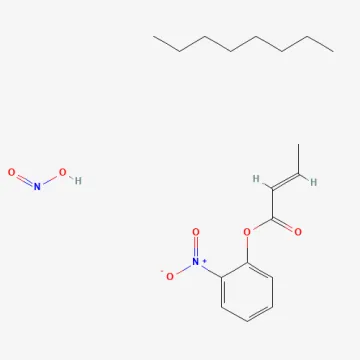
Dinocap
Description
Mode of action
Dinocap belongs to the dinitrophenol chemical class. It is a contact pesticide that exhibits significant fungicidal and acaricidal properties.
The mechanism of action is based on the uncoupling of oxidative phosphorylation in the cells of pathogens and pests.
In fungal cells, the compound suppresses respiratory processes, leading to the rapid death of mycelium and spores of the disease agent.
The acaricidal effect is manifested through the disruption of the energy metabolism in mites, causing paralysis and death at all life stages.
The product possesses high initial activity, allowing for the rapid containment of infection within affected areas.
What it targets
The primary purpose of Dinocap is the control of powdery mildew fungi on a wide range of agricultural crops.
It is effective against various species of powdery mildew pathogens, including grape oidium and gooseberry mildew.
Alongside its fungicidal action, the compound demonstrates high efficacy against spider mites.
It is applied to vegetable crops in open and protected ground, fruit trees, vineyards, and ornamental plants.
- Grapevines (Oidium)
- Cucumbers and tomatoes (Powdery mildew)
- Apple trees (Powdery mildew)
- Fruit trees (Mites)
Rates and timing
Application rates for the product vary depending on the crop type, level of infestation, and the plant growth stage.
Treatments are performed by spraying upon the appearance of the first disease symptoms or when the economic threshold for mites is reached.
It is crucial to ensure uniform coverage of all plant vegetative organs with the working solution for maximum contact efficacy.
The interval between applications typically ranges from 7 to 12 days, depending on pathogen development intensity and weather conditions.
The final application must be carried out in compliance with the established pre-harvest intervals specified in the product regulation.
Restrictions
Dinocap is a toxic compound that requires strict adherence to safety measures during the preparation and application of the working solution.
It is not recommended to use the product at high air temperatures, as this can lead to phytotoxicity, specifically leaf burns.
Exposure to water bodies must be avoided, and application should be excluded during periods of active bee foraging.
Personal protective equipment for skin, respiratory, and eye protection is mandatory to prevent accidental poisoning during handling.
The product must be stored in its original packaging away from food products in areas inaccessible to unauthorized persons and children.
Status in the European Union
Not approved in the EU
- Category (EU)
- AC - Acaricide
- ADI
- 0.004 mg/kg bw/day
- ARfD
- 0.004 mg/kg bw
- AOEL
- 0.003 mg/kg bw/day
EU status is for reference only and does not replace national registration in your country.