
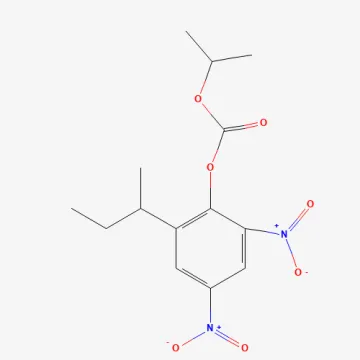
Dinobuton
Description
Mode of action
Dinobuton belongs to the dinitrophenol chemical class and functions as a contact acaricide and fungicide. It primarily acts by uncoupling oxidative phosphorylation within the mitochondria of pests.
By disrupting the cellular energy metabolism, the substance effectively stops the feeding process of mites and fungal pathogens, leading to their rapid mortality upon contact.
The compound remains highly active even at lower temperatures, which allows for early-season application when mite populations begin to emerge after the winter period.
Because its mode of action is purely contact-based, consistent and thorough spray coverage is essential to reach all parts of the plant where mites or fungal spores are present.
In addition to controlling adult stages, the substance provides ovicidal effects, helping to reduce the overall density of the next generation of mites on the treated crop.
What it targets
The primary use of Dinobuton is the management of various mite species, particularly spider mites, which are major pests in fruit orchards and vineyards globally.
Beyond its acaricidal properties, the chemical acts as a fungicide, providing a dual-action benefit by suppressing the development of powdery mildew on foliage.
It is predominantly applied on fruit-bearing trees such as apples, pears, and stone fruits, as well as on vines, where mite infestation can lead to rapid leaf yellowing and senescence.
Targeting pests early in their life cycle is crucial for maintaining the economic threshold and ensuring that tree vigor and fruit quality are not compromised during the season.
- Spider mites (Tetranychidae)
- Rust mites
- Powdery mildew fungi
Rates and timing
Application rates are determined by the specific product formulation and the severity of the infestation, and they should be strictly followed according to the label instructions.
Treatments are usually scheduled upon the threshold detection of pests, with a standard limit on the number of applications per season to manage resistance risks.
Application should ideally take place under calm weather conditions during the early morning or evening to avoid rapid evaporation and to minimize exposure to non-target insects.
Thorough coverage of both the upper and lower leaf surfaces is mandatory to ensure the contact activity of the substance, especially when high foliage density is present.
Maintaining an appropriate spray interval is vital to ensure that the chemical remains effective without causing undue stress to the host plants during sensitive growth stages.
Restrictions
Dinobuton is hazardous to human health if mishandled and poses significant risks to aquatic life and honeybees, requiring strict adherence to environmental safety regulations.
Application during the blooming period of crops is strictly prohibited to protect essential pollinators, ensuring that treatments are performed only after flower petals have fallen.
Personal Protective Equipment (PPE), including chemical-resistant gloves, coveralls, goggles, and respiratory protection, is mandatory for all personnel involved in mixing and application.
Strict disposal protocols must be followed to prevent contamination of surface water and groundwater, as the chemical can be highly toxic to aquatic organisms.
Storage must be in a secure, well-ventilated location that is locked and separated from food, animal feed, and other incompatible materials to prevent accidental exposure.
Status in the European Union
Not approved in the EU
- CAS number
- 973-21-7
- Category (EU)
- AC - Acaricide
EU status is for reference only and does not replace national registration in your country.