
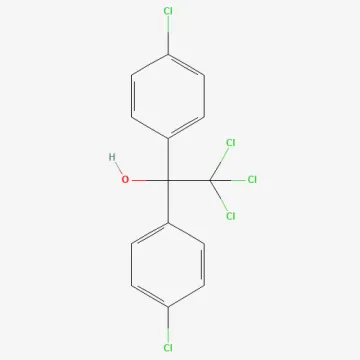
Dicofol
Description
Mode of action
Dicofol belongs to the chemical class of organochlorine compounds (diphenyl ethanol derivatives). According to its mechanism of action, it acts as a contact acaricide with no systemic properties in plants.
The substance affects the nervous system of pests, causing paralysis and subsequent death. It effectively targets all motile stages of mite development, including larvae, nymphs, and adults.
The product is characterized by a pronounced ovicidal action, meaning its ability to suppress embryo development within eggs laid by pests on leaf surfaces.
Due to its lipophilic nature, the active component adheres well to the waxy layer of leaves, providing a long period of protective action after application.
Dicofol does not move within plant tissues, so it is critical to ensure full and uniform coverage of the leaf surface with the working solution to achieve high efficacy.
What it targets
The primary purpose of this substance is to eliminate phytophagous mites from the families of spider mites, gall mites, and other species that damage agricultural crops.
The product was widely used on fruit trees (apples, pears, citrus) to control red fruit mites and brown fruit mites.
In vegetable farming, it was used to protect cucumbers, tomatoes, and eggplants grown in both open and protected ground against common spider mites.
Dicofol was also applied to industrial crops, including cotton and vineyards, where mite populations can reach critical levels during hot periods.
It should be noted that due to the development of pest resistance, the effectiveness of Dicofol has significantly decreased in many regions over recent decades.
Rates and timing
Application rates for the product vary depending on the specific crop, the level of pest infestation, and the spraying equipment used.
Typically, working concentrations range from 0.1% to 0.2% by product formulation, which provides a reliable protective barrier on the vegetative parts of plants.
Pre-harvest intervals must be strictly observed to prevent the accumulation of residual amounts of the substance in marketable produce.
The number of treatments per season is limited to avoid the emergence of resistant mite populations; rotation with acaricides from other chemical groups is recommended.
The optimal time for application is the onset of mass pest appearance, at air temperatures above 15-20 degrees Celsius, as acaricidal activity increases with warmth.
Restrictions
Dicofol is a toxic compound for many beneficial insects and aquatic organisms, so spraying near water bodies and apiaries is strictly prohibited.
Due to its long half-life in soil and accumulation in the environment, the use of products based on this substance is restricted or completely banned in many countries today.
When handling the product, the use of personal protective equipment for skin, respiratory, and eye protection is required, as the substance can penetrate through skin.
Mixing with strongly alkaline preparations, such as Bordeaux mixture or lime-sulfur, is not allowed due to the risk of chemical degradation of the active ingredient.
Storage should be carried out in original packaging in cool, dry warehouse facilities, inaccessible to children and pets, and separate from food products.
Status in the European Union
Not approved in the EU
- CAS number
- 115-32-2
- Category (EU)
- AC - Acaricide
- ADI
- 0.002 mg/kg bw/day
- ARfD
- 0.15 mg/kg bw/day
EU status is for reference only and does not replace national registration in your country.