
PVC fittings for irrigation systems: how to choose connections
Which PVC fittings are used in irrigation systems, how couplings, elbows, and tees differ, and what to consider when assembling a pipeline for your farm.
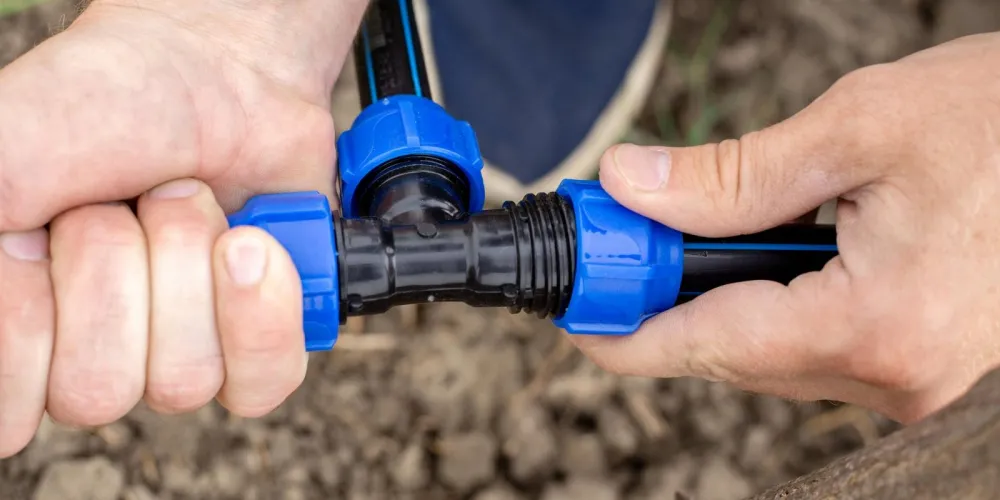
The reliability of an irrigation system depends not only on the pump and the pipe itself. Most potential leaks and installation errors are related to joints, branches, and equipment connections. Therefore, PVC fittings should be selected at the same time as the pipes, taking into account the diameter, operating pressure, type of connection, and the operating conditions of the entire irrigation network.
PVC-U fittings are used in water supply, water treatment, and irrigation: they are used to assemble bends and branches, transition between diameters, and connect equipment.
What tasks do fittings solve?
It is rarely possible to assemble a straight section of pipeline using only pipes. If the line changes direction, elbows are used. To branch water to a separate line, tees or crosses are needed, and for connecting two straight sections — couplings. When transitioning to a different diameter, transition elements are used.
Detachable connections form a separate group. They are especially convenient next to pumps, filters, valves, and other equipment that must be periodically removed for cleaning or repair. If every such assembly were made completely permanent, maintaining the system would become significantly more complicated.
Why PVC-U is used in irrigation systems
Unplasticized polyvinyl chloride is not subject to corrosion from constant contact with water and has a smooth inner surface. This is important for pipelines that operate all season and have a large number of connections.
The material is designed for specific pressure and temperature ranges. Therefore, when designing irrigation, one should focus not only on the diameter of the product but also on the actual parameters of the pump and the network. Excessively high pressure can become a problem even with a correctly executed connection.
Glue and threaded connections: what is the difference?
PVC-U glue fittings are connected to the pipe by cold welding. A special compound is applied to prepared surfaces, after which the parts are joined. A correctly executed assembly is airtight and permanent.
Threaded connections are used where it is necessary to connect equipment or another type of valve. It is important not to confuse the purpose of the connections: threads are convenient for detachable assemblies, while glue assembly is for permanent sections of the pipeline.
In practice, both options are often used in a single system. For example, the main line and branches can be assembled using glue connections, while detachable assemblies can be provided near filters, pump groups, or removable elements.
How to choose fitting diameter
The diameter of the pipeline is chosen based on water flow rate and the required pressure at the most distant points. This is especially important for long main lines and the simultaneous operation of several branches. If the diameter is too small, pressure losses increase, and irrigation in distant areas may become less uniform.
Fittings must correspond to the size of the chosen pipe and the system standard. One should not rely only on visual matching: products of different standards may have different outer dimensions and seating parameters. When purchasing components, it is better to form a unified specification in advance.
What to consider for a branched irrigation system
In greenhouses, gardens, and at production sites, water often needs to be distributed between several zones at once. In this case, it is useful to divide the main line into branches and provide the ability to shut off individual sections. This way, one part of the network can be serviced without stopping the entire system.
Typical installation errors
One common mistake is to start assembly without a finished plan. As a result, unnecessary transitions, incompatible elements, and inconveniently located detachable assemblies appear.
Surface preparation is important for glue connections. Contamination, moisture, an uneven end, or a violation of curing time can reduce the reliability of the assembly. After assembly, it is necessary to wait for the connection to set before applying operating pressure.
Another mistake is to assemble the entire system without considering future repairs. Filters, pumps, and valves require maintenance, so access to them and the possibility of disassembly are best provided for during the design phase.
How to assemble a system without unnecessary connections
First, determine the water source, flow rate, main line length, and the number of irrigation zones. Then choose the pipes, calculate the branches, and draw up a list of couplings, elbows, tees, transitions, and detachable connections.
This approach allows for a reduction in the number of incidental joints and allows for checking the compatibility of parts in advance. The characteristics of pipes and connecting elements for irrigation systems can be compared at the "Afinara" online store of pipes and fittings, comparing them with the parameters of the designed network.
Editorial team agronom.info
Materials are prepared by the portal's agronomists and editors. We use only trusted sources: Ukrainian agricultural universities, variety registries, open scientific publications.
Related articles
Not yet comments. Be the first!
Comments