
Why Phosphorus Availability for Plants Depends on More Than Just the Application Rate
What phosphorus uptake by plants depends on, and how temperature, humidity, soil pH, and application method affect its availability.
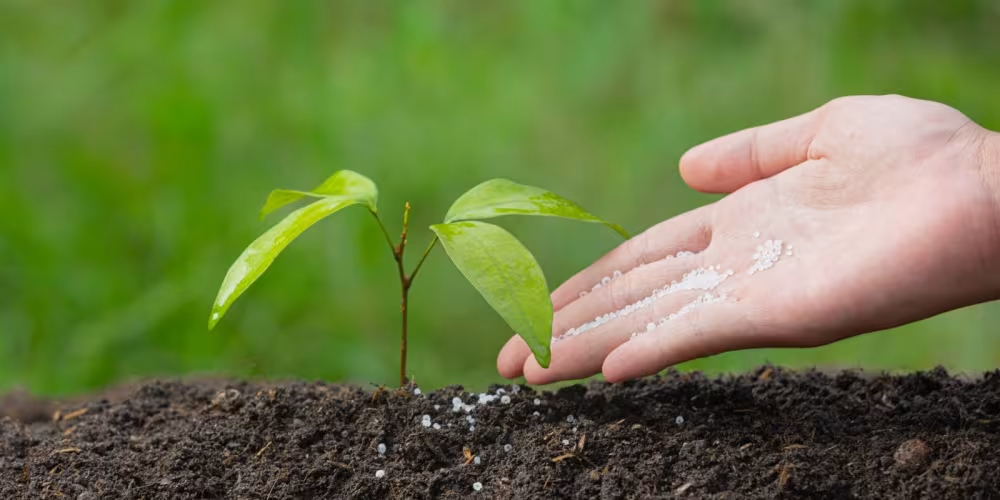
You can apply the calculated rate of phosphorus and still see signs of its deficiency. This happens especially often in spring: the fertilizer is in the soil, analysis shows decent reserves, and young plants develop slowly. The reason is that the amount of the element and its availability to the roots are not the same thing.
Phosphorus is generally quite immobile. It does not move toward the roots as easily as nitrate nitrogen. Therefore, the result depends on the application site, temperature, humidity, soil acidity, and the condition of the root system.
Cold Soil Can Slow Down Phosphorus Nutrition
In early spring, this problem is clearly noticeable on corn. Young plants sometimes acquire a purple tint even though the farm applied phosphorus in the planned amount. This does not necessarily mean that there is physically little of it.
In cold soil, roots work more slowly. At the same time, the processes that make phosphorus available to the plant slow down. Until the earth warms up, the crop may experience a deficiency for some time, even with a normal total content of the element.
A similar situation arises with excess moisture. Waterlogging impairs root function, and simply adding more fertilizer here will not always help.
Soil Reaction Is No Less Important
Phosphorus easily interacts with other compounds. In acidic soils, it can bind with aluminum and iron, and at high pH — with calcium. As a result, part of the applied element turns into forms from which it is more difficult for the plant to obtain it.
That is why two neighboring plots with the same application rate can produce different crop responses. If the pH is in a favorable range on one and there is strong acidification on the other, the effectiveness of the same dose will vary.
Before increasing the rate, it is more useful to check the state of the soil. Sometimes the problem is solved not by additional kilograms of phosphorus, but by correcting acidity.
Where the Granule Landed
Due to the weak mobility of phosphorus, the distance between the fertilizer and the young root is of practical importance. If the entire reserve is distributed in a layer that the root system has not yet reached, the plant will not be able to quickly use it.
Therefore, phosphorus fertilizers are applied not only broadcast for primary tillage. Part of the rate can be applied locally during sowing, placing granules near the future root system. This way, the young plant does not need to explore a large volume of soil to find available phosphorus.
However, placing concentrated fertilizer directly together with the seed is also not always correct. The placement method depends on the crop, product type, and rate. For starter nutrition, it is important that the granule is close enough to the roots, but does not create an unwanted concentration of salts near the seed.
A Larger Rate Does Not Always Fix the Situation
When a crop poorly absorbs phosphorus, the first reaction is to add more. But if the cause is low temperature, inappropriate pH, or poor root development, additional kilograms may change very little.
In addition, unused phosphorus does not necessarily disappear from the field. Part of it remains in the soil and gradually turns into less accessible compounds. Thus, you can increase the reserves of the element for years without getting a proportional increase in yield.
Therefore, it is better to consider the rate together with the application method. For one field, basic application in autumn will be appropriate, for another — part of the rate in basic and a small starter dose during sowing. And in case of acidity problems, you should first work with the soil itself. In the case of phosphorus, it is important not only how much was applied per hectare, but also whether the roots will be able to reach it precisely when the crop needs it most.
Editorial team agronom.info
Materials are prepared by the portal's agronomists and editors. We use only trusted sources: Ukrainian agricultural universities, variety registries, open scientific publications.
Related articles
Not yet comments. Be the first!
Comments · 0