
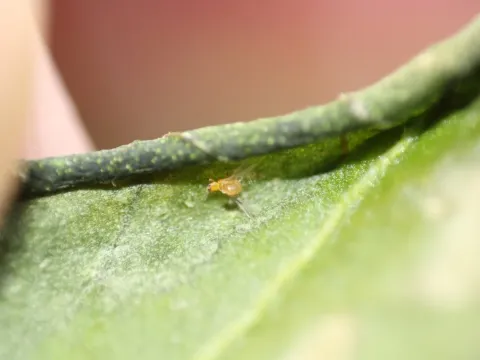
Onion thrips
Thrips major
Thrips major, commonly known as a type of thrip, belongs to the order Thysanoptera. These insects are microscopic, usually measuring between 1 to 1.5 mm in length, with slender bodies varying in color from light brown to dark brown.
What the section contains
Onion thrips
The adults are characterized by two pairs of thin wings, which are fringed with long hairs, allowing for basic flight and dispersal between plants.
Their life cycle consists of the egg, larva, propupa, pupa, and adult stages. Under favorable conditions, the development from egg to adult can occur very rapidly.
They overwinter as adults in protected areas, such as soil debris or sheltered plant stalks, ensuring they are present early in the growing season.
The species exhibits high reproductive potential, allowing populations to explode within a short period, especially in greenhouse environments.
This pest is a major polyphage, attacking a wide range of vegetables, flowers, and ornamental crops, which makes it a persistent issue for professional growers.
By using their rasping-sucking mouthparts, thrips pierce plant cells and consume the contents, leading to the collapse of plant tissue and loss of chlorophyll.
Damage often manifests as stunted growth, misshapen fruit, and poor overall plant health, significantly reducing the market value of the produce.
Besides physical injury, they are notorious for transmitting plant viruses, such as Tomato Spotted Wilt Virus, which can devastate entire fields.
In high concentrations, the constant feeding causes severe yellowing and drying out of the leaves, eventually leading to plant death if left untreated.
Early symptoms include tiny white or silver streaks and stippling on the leaves, which are the result of air entering the empty cells that were previously drained.
One of the most reliable diagnostic signs is the presence of small, dark fecal spots left behind on the underside of the leaf by the feeding insects.
Flower buds often fail to open properly or exhibit blotchy, irregular colors on the petals as the thrips feed on the developing floral tissues.
In heavily infested plants, leaves may appear crinkled, become brittle, and eventually drop prematurely, hindering the plant's ability to photosynthesize.
- Silvery or whitish streaking on foliage.
- Small dark fecal spots (droppings) on leaves.
- Deformed or streaked flower petals.
- Stunted plant growth and reduced vigor.
Cultural practices are essential; keeping the field free of weeds and destroying crop residues after harvest eliminates critical overwintering sites.
Blue sticky traps are widely used in agricultural settings to detect the arrival of adult thrips early and to monitor population spikes during the season.
Chemical control involving systemic insecticides is often necessary when threshold levels are exceeded, ensuring the compound reaches the pest inside the plant tissue.
Biological control agents, such as predatory mites (Amblyseius species) or minute pirate bugs (Orius), provide an excellent alternative to chemicals in greenhouses.
Rotation of pesticide modes of action is critical to manage insecticide resistance, as thrips are known to develop tolerance to commonly used active ingredients.