
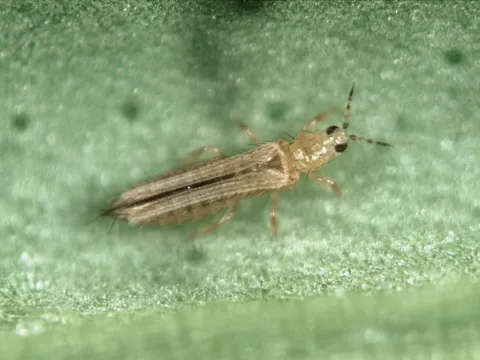
Orchid thrips
Dichromothrips corbetti
The orchid thrips, Dichromothrips corbetti, is a small insect species belonging to the order Thysanoptera and the family Thripidae. These pests are notorious for causing significant aesthetic and physical damage to various orchid species.
What the section contains
Orchid thrips
Adults are very small, typically measuring between 1 and 1.5 millimeters in length. They are characterized by a dark brown or black elongated body and thin wings bordered with fine fringes, which gives the group its scientific name.
The life cycle of the pest consists of egg, two larval stages, prepupa, pupa, and adult. This complete metamorphosis allows the population to survive in various micro-environments, especially within the protective layers of tightly packed orchid leaves and buds.
These insects are highly active in warm, humid greenhouse environments. Their ability to reproduce both sexually and parthenogenetically leads to rapid population explosions if left unchecked by the grower.
Because of their minute size and secretive behavior, they are often overlooked until the damage becomes visually apparent, making early identification through inspection vital for orchid health.
Dichromothrips corbetti primarily targets members of the Orchidaceae family, with a high preference for Dendrobium, Vanda, and Phalaenopsis orchids, causing severe disruptions in growth and flowering.
The feeding mechanism involves piercing the epidermis of plant tissues with their mouthparts and sucking out the cell contents. This leads to the collapse of cells and the death of the surrounding tissue area.
Physical damage is most evident on leaves, which develop characteristic silver-grey streaks or mottled patches, often resulting in a decline in the plant's overall photosynthetic efficiency.
When the thrips feed on buds or blooming flowers, they cause severe malformations, streaks, and spots on the petals, rendering the flowers commercially worthless for growers and unattractive for collectors.
Repeated feeding cycles eventually weaken the host plant, leaving it susceptible to secondary infections from fungi and bacteria that enter the plant through the puncture wounds left by the thrips.
Visual symptoms often start with a silvery or whitish discoloration on the surface of leaves, which appears as if the tissue has been etched or scratched by a fine needle.
Small, dark spots of excrement left behind on the foliage or the base of the flower are a classic sign of an established infestation, often found in the crevices of the plant.
Deformed or asymmetrical flower development, along with a lack of vigor in new shoots, can indicate that thrips have been feeding on the plant while the structures were still developing.
Using a magnifying glass to inspect the inner parts of the flowers or between the leaf axils often reveals the presence of tiny, pale-yellow larvae moving rapidly when disturbed.
In cases of high infestation, the foliage may begin to yellow prematurely or curl, and flower buds may fail to open entirely, dropping off before they reach maturity.
Management starts with maintaining proper sanitation, which includes removing and destroying all infested plant parts and regularly cleaning the growing area to eliminate hidden pupation sites.
Blue sticky traps are highly recommended, as Dichromothrips corbetti is significantly more attracted to blue than yellow, making these traps an excellent tool for monitoring and reducing adult populations.
Chemical control should involve systemic insecticides labeled for use on ornamentals. It is essential to apply treatments as a multi-step program, repeating applications at short intervals to target newly hatching larvae.
Biological control using predatory mites such as Amblyseius cucumeris is a sustainable and effective strategy, especially in protected greenhouse environments where chemicals might be restricted.
Rotating different modes of action for chemical pesticides is critical to prevent the thrips from developing resistance, a common phenomenon in environments where chemical control is used exclusively.