
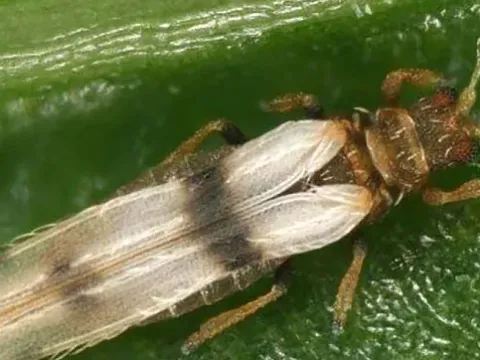
Flax thrips
Thrips lini
The flax thrips (Thrips lini) is a small insect belonging to the order Thysanoptera and the family Thripidae. These insects typically measure about 1 mm in length and possess slender, yellowish-brown bodies.
What the section contains
Flax thrips
Adults are equipped with two pairs of narrow wings featuring characteristic fringes of long hairs. Nymphs closely resemble the adults in morphology but lack wings and appear lighter in coloration.
These pests prefer a cryptic lifestyle, often hiding in leaf axils or deep within flower buds. This behavior makes them difficult to spot during routine field inspections without careful examination.
Reproduction is sexual, with females laying eggs directly into the plant tissue using a sharp ovipositor. This biological trait allows them to colonize host plants efficiently throughout the growing season.
They overwinter primarily as adults in soil crevices, plant debris, or on nearby weeds, emerging in early spring to locate new host plants as temperatures rise.
The primary host plant for Thrips lini is cultivated flax (linseed and fiber flax). The damage is caused by both adults and larvae feeding on plant cell contents.
The most severe damage occurs during the budding and flowering stages of the flax crop. Feeding activity drains sap from the reproductive organs, leading to significant yield loss.
When thrips feed, they inject toxic saliva into the plant tissues. This causes distortion of leaves and flower buds, often preventing the flowers from opening properly.
Heavy infestations can lead to stunted plant growth, deformed stems, and total loss of seed capsules, which drastically reduces both the quality and quantity of the harvest.
In hot and dry weather conditions, the stress on plants is exacerbated, making them more vulnerable to thrips damage and significantly increasing the economic impact of the infestation.
Emergence from hibernation occurs in early spring once soil temperatures exceed 10-12 degrees Celsius, aligning with the germination phase of the flax crop.
Peak population densities are observed during the budding phase of flax. Favorable weather, specifically high temperatures and moderate humidity, accelerates their life cycle.
The species can complete several generations within a single growing season, allowing population numbers to surge rapidly if not managed correctly.
As the flax reaches maturity and tissues become tougher, the adults initiate migration towards wintering sites, often moving to perennial grasses or wooded hedgerows.
Environmental cues such as declining daylight hours and cooling temperatures trigger the transition into diapause, ensuring survival through the winter months.
Early symptoms include small silvery or whitish spots and streaks on the leaves. These patches often merge, leading to premature yellowing and curling of the foliage.
Deformation of the plant apex is a classic sign of infestation. Bud growth is often arrested, and buds may wither and fall off without fully blooming.
Stems may display patchy discoloration, which affects the structural integrity and marketability of fiber flax. This damage renders the crop significantly less valuable.
Presence of the insects themselves can be confirmed by inspecting the bases of the leaves or the interior of the buds, where they tend to aggregate in larger numbers.
- Silvery discoloration on leaves
- Stunted and deformed plant tips
- Bud withering and abortion
- Overall loss of plant vigor
Strategic crop rotation is the most effective cultural practice to manage flax thrips, as it breaks the life cycle by ensuring host plants are not present in the same field annually.
Deep fall plowing helps bury plant debris and destroys overwintering sites, significantly reducing the initial population pressure for the next spring cycle.
Controlling weeds in and around the field margins is essential, as these plants often serve as early-season reservoirs for the pest before they move to the main crop.
If economic thresholds are reached, the application of systemic or contact insecticides is recommended during the budding stage to prevent damage to reproductive tissues.
Integrated Pest Management (IPM) practices should be employed to protect natural predators, ensuring a sustainable approach to controlling the thrips population in the field.