
Echinothrips americanus
Echinothrips americanus
Description
How to identify
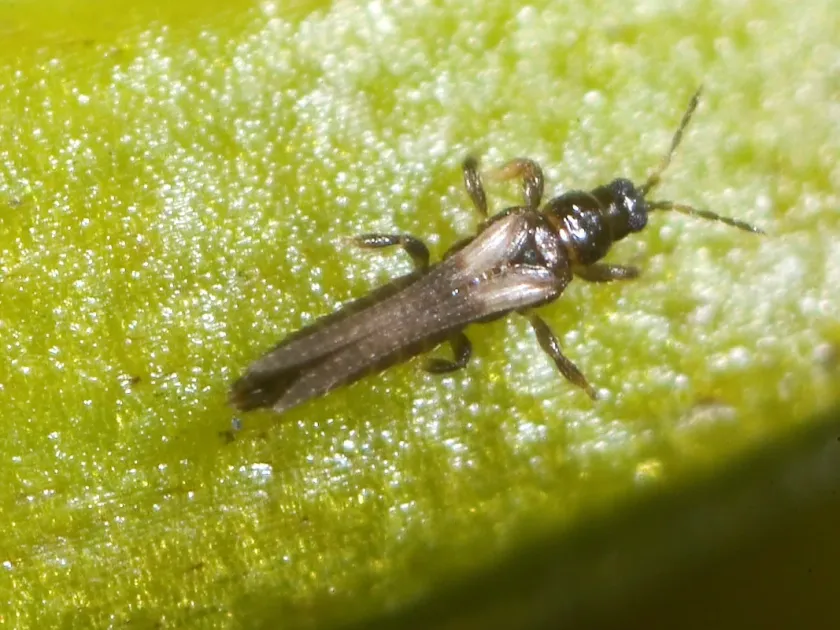
Echinothrips americanus is a small insect belonging to the order Thysanoptera and the family Thripidae, commonly known as the American thrips.
The adult insect is dark brown to black, measuring approximately 1.5 to 2 mm in length, making it difficult to spot against darker foliage.
A diagnostic feature of this species is a distinct white patch at the base of the wings, which forms a triangular mark when the wings are folded.
Larvae are pale yellow or translucent and are usually found on the underside of leaves, exhibiting high mobility despite their microscopic size.
The life cycle encompasses eggs, two larval stages, prepupal, and pupal stages, with pupation often occurring in the soil or protected crevices.
What it damages
This pest is highly polyphagous, meaning it feeds on a vast array of plant species, particularly those grown in controlled environments like greenhouses.
Common hosts include ornamental plants such as impatiens, begonias, and fuchsias, as well as vegetables like peppers and cucumbers.
The insects feed by piercing the plant epidermis and sucking out the cell contents, which destroys the cellular structure of the leaf tissue.
Severe infestations result in heavy damage to the foliage, characterized by widespread silvering and chlorosis, significantly reducing the plant's aesthetic and commercial value.
In addition to direct feeding damage, they can act as vectors for various plant viruses, further complicating the impact on crop yield and health.
When it appears
Within greenhouse environments, Echinothrips americanus can complete its life cycle year-round, as the stable climate prevents winter dormancy.
Optimal conditions for rapid reproduction are temperatures between 25°C and 30°C, where a single generation can develop in as little as two to three weeks.
During summer months, the pest may spread to outdoor gardens, infesting various landscape plants and weeds surrounding the production site.
Re-entry into greenhouses often occurs via infested plant material, highlighting the importance of quarantine for all incoming stock.
Winter populations may remain active at low levels if heat is maintained, making continuous monitoring essential throughout the calendar year.
Signs of infestation
The earliest symptom of an infestation is the appearance of small, silvery, or bleached spots on the leaf surface, caused by the destruction of cells.
These spots often coalesce as the feeding intensity increases, leading to large discolored patches and necrotic areas on the leaf blades.
Black, shiny deposits of excrement on the underside of leaves are a definitive sign of Echinothrips americanus presence, distinguishing it from other pests.
Leaf curling, deformity, and premature leaf drop are common in heavily infested plants, causing significant stress to the host.
Close inspection of the underside of the leaves usually reveals the presence of both adults and larvae, which move quickly when disturbed.
Control measures
An effective management program relies on a combination of rigorous sanitation, biological control, and targeted insecticide applications.
Blue sticky traps are highly recommended for monitoring populations and identifying the early stages of an infestation before it spreads.
Biological control agents, such as predatory mites (e.g., Amblyseius swirskii), can be very effective in suppressing the pest population.
Chemical control should be rotational to prevent the development of resistance, utilizing systemic products applied to the roots or foliar sprays.
- Strict quarantine for all new plant introductions.
- Regular removal of weeds and debris in and around the greenhouse.
- Sanitizing tools and benches between crop cycles.
- Maintaining optimal relative humidity to stress the pest population.
Taxonomy
- Latin name
- Echinothrips americanus
- Order
- Thrips
- Family
- Thripidae
- EPPO code
- ECHTAM
Discussion
No discussions yet — be the first.