
Ethiopian thrips
Hercinothrips aethiopiae
Description
How to identify
The Ethiopian thrips (Hercinothrips aethiopiae) is a member of the Thripidae family, widely recognized for its impact on ornamental and tropical plants in controlled environments.
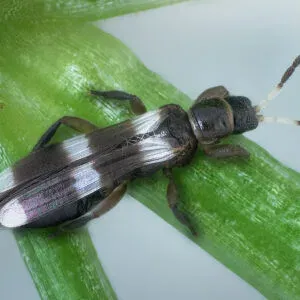
Adult insects are tiny, typically measuring 1.0 to 1.5 mm, with a dark brown to black coloration. Their wings show distinct venation patterns that help in accurate taxonomic classification.
The life cycle encompasses several stages: egg, two larval instars, prepupa, pupa, and adult. This metamorphic process is highly influenced by ambient temperature and relative humidity.
They prefer to hide in protected microhabitats such as leaf axils, the underside of leaves, and within the tightly packed structures of developing flower buds.
High humidity and warm temperatures significantly accelerate their reproductive rate, allowing a population to explode within a relatively short period in greenhouse conditions.
What it damages
Damage is caused by the insect using its rasping-sucking mouthparts to pierce the epidermal cells of the plant tissue, extracting the sap and cellular contents.
This feeding activity results in the loss of chlorophyll and cell destruction, appearing as silvery or pale patches on the surface of the affected foliage.
Ornamental plants suffer from severe aesthetic degradation due to leaf deformation, necrosis, and the stunted development of shoots and terminal buds.
Beyond direct feeding damage, these thrips serve as vectors for various plant viruses, which can lead to systemic diseases and total crop failure.
In cases of heavy infestation, the entire plant weakens significantly, leading to the yellowing of leaves, premature senescence, and ultimately the death of the plant.
Signs of infestation
A primary diagnostic sign is the appearance of silvery, metallic-looking streaks on the upper leaf surface, created by the infiltration of air into damaged cells.
Tiny black fecal deposits, often seen as minute dots, are a characteristic indicator of an active thrips colony, usually concentrated on the lower side of leaves.
- Wilting of leaves despite adequate soil moisture levels.
- Deformation and curling of new, tender growth.
- Premature shedding of buds and stunted flower development.
Sticky, varnish-like secretions may also be visible on the surface of the plant, especially near the base of the stems or in the nodes.
Monitoring the undersides of the leaves during the early morning hours provides the best chance to spot the larvae before they cause widespread structural damage.
Control measures
Effective management begins with strict sanitation practices, including the quarantine of new plants to prevent the introduction of the pest into the greenhouse.
Deploying blue or yellow sticky traps is a standard monitoring technique that effectively captures flying adults and reduces the reproductive population.
Systemic insecticides should be applied as part of an integrated pest management (IPM) program, ensuring the rotation of active ingredients to prevent resistance.
Biological control using predatory mites or pirate bugs is an excellent strategy for reducing thrips populations in greenhouses without relying solely on chemical pesticides.
Follow-up treatments are essential to target subsequent generations of larvae emerging from eggs deposited within the plant tissue, ensuring complete lifecycle disruption.
Taxonomy
- Latin name
- Hercinothrips aethiopiae
- Order
- Thrips
- Family
- Thripidae
- EPPO code
- HERCAE
Discussion
No discussions yet — be the first.