
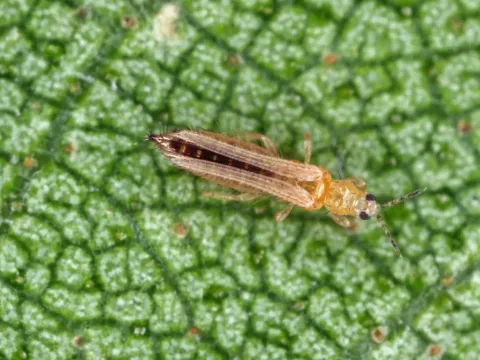
Flower thrips
Thrips florum
Flower thrips (scientific name: Thrips florum) belongs to the order Thysanoptera, family Thripidae. These are tiny insects, typically measuring between 1 to 1.5 mm in length, known for their slender bodies.
What the section contains
Flower thrips
The adults are usually light yellow to dark brown in color. They possess two pairs of narrow, fringed wings that are folded flat over their backs when the insects are at rest.
The life cycle of the thrips progresses through the egg, two larval stages, propupa, pupa, and adult. The developmental speed depends heavily on ambient temperatures and host plant quality.
Due to their small size and ability to hide deep within flower buds or plant crevices, they are often difficult to detect during the early stages of a population outbreak.
They are highly mobile insects that can quickly colonize new areas, making early detection and rapid response critical for any commercial greenhouse or agricultural operation.
Thrips florum is a significant polyphagous pest that attacks a wide variety of ornamental, vegetable, and fruit crops, including roses, orchids, tomatoes, and citrus fruits.
By piercing plant cells and sucking out the contents, thrips cause significant physiological stress. This damage manifests as stunted growth, leaf discoloration, and necrotic spots.
The feeding activity on flowers is particularly destructive. Infested blooms may suffer from severe deformity, discoloration, and premature abscission, rendering them unfit for sale.
Beyond direct physical damage, these insects are efficient vectors for several plant viruses, such as Tospoviruses, which can cause devastating diseases in various susceptible crops.
In intensive production systems, a heavy thrips infestation can lead to total economic loss of the flowering crop if management strategies are not implemented promptly.
The most common symptom of a thrips infestation is the presence of silver or whitish stippling on the foliage caused by the emptying of individual plant cells.
Tiny black fecal specks on the underside of the leaves serve as a diagnostic indicator of thrips presence and active feeding within the plant canopy.
Buds affected by thrips often fail to open correctly, showing signs of distortion or scarring. Petals may appear withered or possess irregular dark patches due to cell death.
Young shoots and leaves may exhibit curling or twisting. In some cases, the tissue around the feeding site becomes hardened or corky as the plant attempts to heal.
Tapping flowers or foliage over a sheet of white paper is a simple and effective method to dislodge and observe the small, active thrips nymphs and adults.
Integrated Pest Management (IPM) is the gold standard for controlling flower thrips. This begins with rigorous monitoring using blue sticky cards, which are highly attractive to the species.
Good sanitation practices are essential, including the removal of weeds and crop debris that serve as reservoirs for the pest population between growing seasons.
Chemical control should involve the rotation of insecticides with different modes of action to prevent the development of pesticide resistance, which is a common issue with thrips.
Biological control agents, such as predatory mites (Amblyseius spp.) and predatory bugs (Orius insidiosus), have proven highly effective in reducing thrips density in protected cropping systems.
- Implement strict screening of all incoming plant material.
- Use fine-mesh insect screening on greenhouse ventilation systems.
- Manage greenhouse temperature and humidity to stay outside the pest's comfort zone.
- Apply systemic insecticides based on threshold monitoring data.
- Encourage natural predators by avoiding broad-spectrum pesticide use.