

Flax thrips
Thrips angusticeps
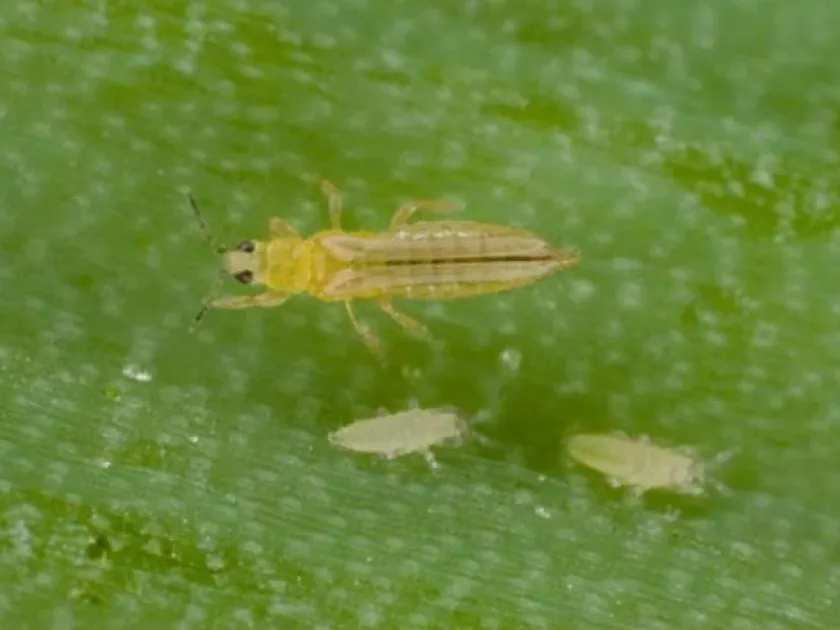
Description
How to identify
The flax thrips (Thrips angusticeps) is a small insect belonging to the order Thysanoptera, specifically within the Thripidae family, known as a significant agricultural pest.
Adult insects are tiny, measuring between 1.0 and 1.5 mm in length, and typically display a dark brown to black coloration, making them difficult to spot on plants.
They possess narrow, fringed wings that enable them to migrate across fields, often traveling long distances to locate suitable host plants for feeding and breeding.
The larval stages are lighter in color, appearing yellowish-white, and are wingless, concentrating their activity primarily on the foliage where they hatched.
This species is highly adapted for survival, capable of entering a diapause state deep within the soil to withstand harsh winter conditions or unfavorable seasonal shifts.
What it damages
While flax is the primary host, Thrips angusticeps is a polyphagous pest, meaning it attacks a wide variety of plant species across different families.
Cereal crops like barley and oats, as well as various legumes, are often damaged, serving as alternative sources of nutrition when flax is not present.
Both adults and larvae feed by piercing plant cells and sucking out the sap, which disrupts the photosynthetic process and weakens the plant's structural integrity.
The most severe damage occurs during the seedling stage, where feeding on the growing tip can cause stunted development or the total loss of the crop stand.
Later in the season, the presence of thrips in flower buds and developing bolls leads to flower abortion and significantly lower seed quality and weight.
When it appears
Adult thrips emerge from their overwintering sites in the soil during early spring as soon as ground temperatures rise sufficiently for insect activity.
Initial colonization often occurs on weeds or winter cereals before the insects migrate to young flax plants, typically during the critical seedling stage.
Hot and dry weather conditions are particularly conducive to rapid population explosions, as these conditions shorten the developmental cycle of the larvae.
The species usually completes one or two generations per year, with the generation infesting flax crops being the most economically damaging to farmers.
As autumn approaches and temperatures drop, the population migrates back into the soil profile to enter diapause, effectively completing their annual life cycle.
Signs of infestation
The earliest signs of infestation are silver or whitish streaks and patches on the leaves, resulting from the desiccation of the punctured epidermal cells.
Affected plants often exhibit leaf curling and crinkling, while severe infestations can result in the twisting of the main stem, limiting growth potential.
Small black fecal spots left on the surface of the leaves are a diagnostic indicator of thrips activity and can be seen even before major damage occurs.
When examining flowers, one might observe discolored petals or deformed reproductive parts, directly indicating that the insects are feeding on the plant's reproductive tissues.
- Silvering or mottling of young leaf surfaces.
- Twisting and distortion of the main growing points.
- Reduced plant vigor and stunted height in seedling crops.
Control measures
Crop rotation is the most fundamental cultural control method, as it prevents the buildup of resident populations in fields dedicated to flax production.
Deep autumn tillage is highly effective in disrupting the overwintering habitat of the larvae, exposing them to environmental stresses that significantly reduce survival rates.
Maintaining clean field borders by eliminating weeds prevents the early-season reservoir of thrips from migrating onto newly emerged flax seedlings.
Chemical control involving systemic insecticides is necessary when monitoring reveals that populations have exceeded the economic threshold for the region.
Timely application during the early vegetative growth stages is crucial, as protecting the growing tip ensures the plant retains its ability to reach full development.
Content graph
Connections · Flax thrips
Most often together:
Marketplace
Products · 2

Biology
Taxonomy
- Latin name
- Thrips angusticeps
- Order
- Thrips
- Family
- Thripidae
- EPPO code
- THRIAN
Community
Discussion
No discussions yet — be the first.