
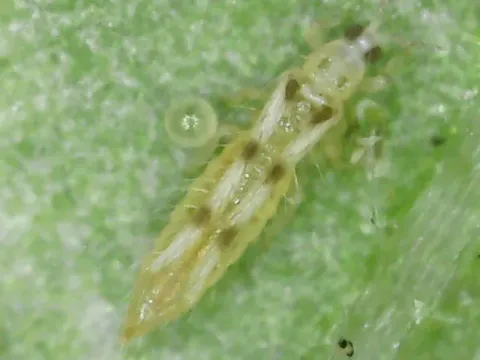
Predatory thrips
Scolothrips
Predatory thrips, belonging to the genus Scolothrips (family Thripidae), are specialized beneficial insects known for their ability to prey upon spider mites.
What the section contains
Predatory thrips
The adults are approximately 1 mm long, typically pale yellow or brownish in color, and feature elongated, hair-like bristles on their wings, which is a diagnostic trait for this genus.
They possess piercing-sucking mouthparts, which they use to penetrate the exoskeleton of their prey and consume the internal fluids, effectively killing the mites.
Larvae resemble adults but lack wings and are smaller; they are highly mobile and are voracious predators of both mite eggs and adults.
The life cycle progresses through egg, larval, and pupal stages, with developmental speed highly dependent on temperature and prey availability.
These insects are not considered pests of agricultural crops; on the contrary, they are valuable natural enemies used in biological control programs.
They feed primarily on various species of spider mites (Tetranychidae) that infest vegetable crops, orchards, and ornamental plants.
Because they act as predators, they help prevent economic damage from mite outbreaks, reducing the need for chemical intervention.
Instances of phytophagy (feeding on plant tissue) by Scolothrips are virtually non-existent and of no economic importance to commercial growers.
Their presence in a field is a sign of a healthy, balanced agroecosystem where natural regulation of pests is functioning effectively.
Predatory thrips become active in the spring when temperatures rise, typically starting above 15°C, following the emergence of their mite hosts.
Their peak population density is observed during the summer months when hot, dry conditions favor the rapid reproduction of spider mites.
They overwinter as adults in protected locations, such as leaf litter, bark crevices, or the upper layers of the soil.
The number of generations per season varies depending on the climate, often allowing for rapid population build-up in response to mite infestations.
As autumn approaches and temperatures drop, their metabolic activity decreases, and they prepare for their dormancy period.
Signs of predatory thrips activity include the presence of mite colonies on the underside of leaves, accompanied by the visible activity of fast-moving, small predatory insects.
Microscopic examination of infested leaves often reveals empty, collapsed mite eggs and shriveled mite carcasses, indicating the predators have been feeding.
The overall rate of mite infestation and the expansion of webbing are usually significantly reduced in areas where these predators are present.
Predatory thrips are visible as tiny, agile spots darting among the spider mites, rarely staying still for long.
A reduction in the typical yellow stippling on leaves, despite the presence of mites, suggests that the predatory thrips are effectively curbing the mite population.
Since predatory thrips are beneficial, the main goal of management is to conserve and foster their populations rather than control them.
- Avoid the use of broad-spectrum insecticides that are toxic to natural predators.
- Adopt Integrated Pest Management (IPM) practices to ensure the survival of beneficial insects.
- Use selective acaricides if chemical intervention against mites becomes absolutely necessary.
- Maintain floral refuges or cover crops that provide alternative food sources and shelter for the predators.
- Monitor pest populations frequently to detect outbreaks early, allowing for biological or targeted control methods.