
Red-banded thrips
Selenothrips
Description
How to identify
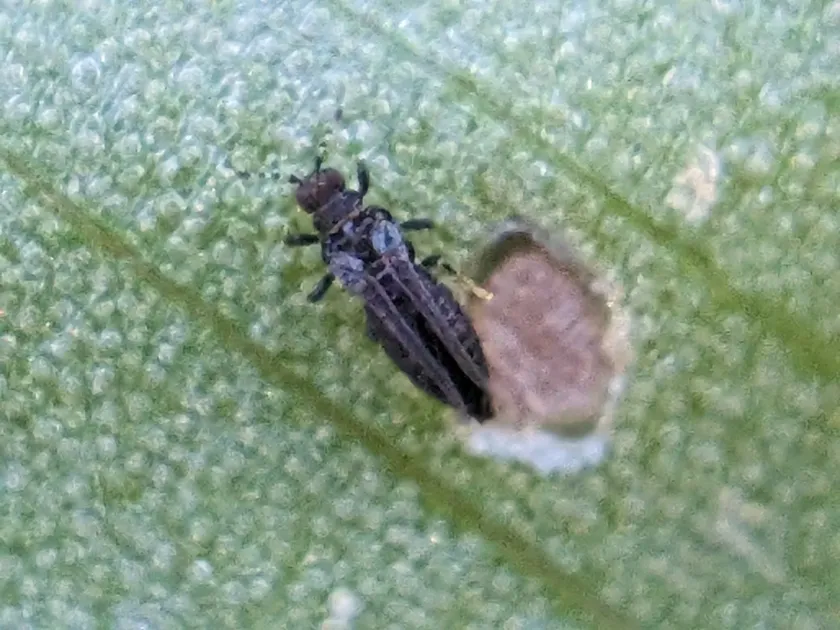
Red-banded thrips (Selenothrips rubrocinctus) is a small insect belonging to the order Thysanoptera and the family Thripidae. Adult thrips are characterized by their dark brown to black body, while the larvae are easily recognized by a distinctive bright red band across their abdomen.
These pests predominantly reproduce through parthenogenesis, a mechanism that allows for rapid population explosions within short timeframes. Females insert their eggs into the leaf tissue, ensuring protection during the initial developmental stages.
The life cycle encompasses several stages: egg, two larval instars, prepupa, pupa, and the adult form. Under optimal conditions of high humidity and temperatures around 25-30°C, the lifecycle is completed in just a few weeks.
They prefer to congregate on the underside of leaves, which provides a sheltered microclimate away from direct sunlight and environmental hazards. This cryptic behavior often leads to infestations going unnoticed until significant damage occurs.
Their mobility and high reproductive potential make them a challenging pest to manage in both tropical plantations and greenhouse environments.
What it damages
The Red-banded thrips is a significant polyphagous pest affecting a diverse range of tropical and subtropical crops, including cacao, mango, avocado, and various nut species. They are known to cause severe economic losses in orchards.
By piercing the leaf surface with their mouthparts, they extract plant sap, which leads to the collapse of epidermal cells. This extraction process directly impairs the photosynthetic efficiency of the plant.
Heavy infestations result in widespread yellowing, desiccation, and premature shedding of leaves. This stress can significantly stunt the development of young plants and reduce yield quality in mature trees.
Beyond direct feeding damage, the insects deposit dark, liquid excrement on the leaf surface, which serves as a substrate for sooty mold fungi. This buildup further interferes with leaf gas exchange and plant health.
Fruit quality is also severely compromised, as feeding often causes corky skin lesions, disfigurement, and skin cracking, which renders the produce commercially unappealing.
Signs of infestation
The earliest signs of an infestation include the appearance of silvery or metallic-colored blotches on the underside of leaves. These areas eventually turn dark brown or black as tissue necrosis progresses.
A tell-tale sign of their presence is the accumulation of small, black, varnish-like spots of excrement on the underside of leaves, which often appear alongside shed larval skins.
Infested foliage often exhibits curling and distortion. As the plant loses vigor, the overall canopy density may decrease due to leaf drop, impacting the plant's structural integrity.
On affected fruits, localized crusting and abnormal skin hardening are clear indicators of past or ongoing thrips activity, distinguishing them from other localized fungal infections.
Upon closer inspection with a hand lens, observers can detect the presence of larvae and adults moving across the undersides of the foliage, particularly near leaf veins.
Control measures
Managing Red-banded thrips requires an integrated pest management (IPM) strategy that combines monitoring, cultural practices, and chemical intervention. Early detection is paramount for minimizing losses.
The use of blue sticky traps is highly effective for monitoring adult populations. These traps provide real-time data on pest density and help time the application of control measures accurately.
Biological control agents, particularly predatory mites (such as Amblyseius species) and predatory bugs, have proven effective in regulating populations, especially in protected environments like greenhouses.
Chemical control should rely on systemic insecticides that can reach the pest within the plant tissues. It is crucial to rotate chemical classes to prevent the development of insecticide resistance.
- Regular scouting of the underside of leaves.
- Sanitation by removing infested plant debris and weeds.
- Implementation of biological control using predatory mites.
- Targeted insecticide applications during early morning or evening hours.
Taxonomy
- Latin name
- Selenothrips
- Order
- Thrips
- Family
- Thripidae
- EPPO code
- SLENSP
Discussion
No discussions yet — be the first.