
Red-banded thrips
Selenothrips rubrocinctus
Description
How to identify
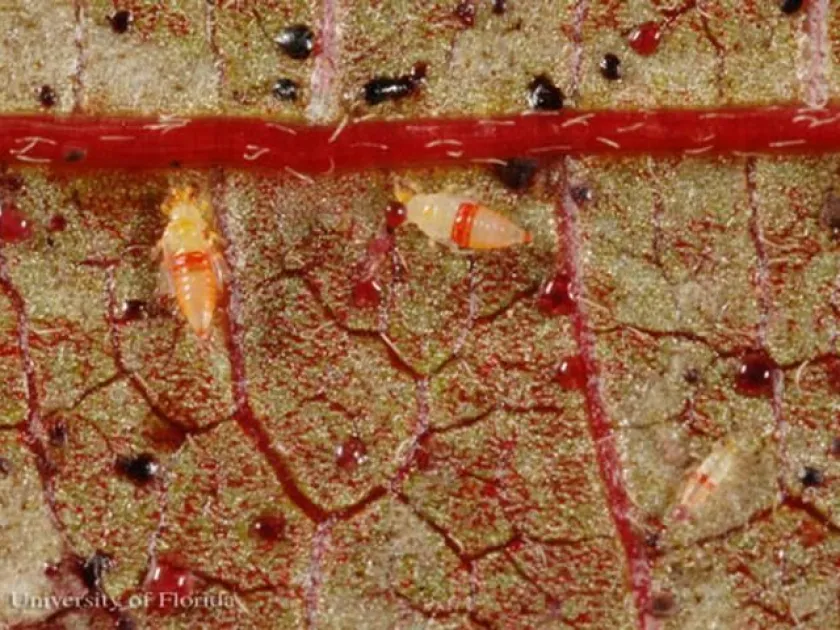
The Red-banded thrips (Selenothrips rubrocinctus) belongs to the Thysanoptera order, Thripidae family. It is easily identified in the larval stage by a distinct red transverse band across the abdomen, which stands out against the pale body.
Adult thrips are dark brown to black, typically measuring about 1–1.5 mm in length. They possess fringed wings, which allow them to fly or be dispersed by wind currents between plants.
The life cycle consists of the egg, two larval instars, prepupa, pupa, and adult stages. Development is highly temperature-dependent and occurs most rapidly in tropical and subtropical climates.
These insects are primarily found on the underside of leaves. They tend to live in colonies, which explains the patchy distribution of damage often seen on host plants.
Due to their preference for warm and humid conditions, they are frequent inhabitants of greenhouses and indoor plant collections in regions where they cannot survive the winter outdoors.
What it damages
This pest is highly polyphagous, attacking a wide range of commercially significant crops such as cocoa, mango, avocado, and cashew, along with many ornamental indoor plants like Ficus.
The insects feed by piercing plant cells and sucking out the sap. This feeding process destroys chlorophyll-containing cells, leading to severe chlorosis and reduced photosynthetic capacity.
Heavy infestations result in leaf curling, yellowing, and premature senescence. In severe cases, significant defoliation can weaken the plant, stunting its growth and reducing yield potential.
Fruit damage is also a major concern. The thrips feed on developing fruits, causing scarring and corky textures on the skin, which significantly lowers the market grade and quality of the produce.
In addition to physical damage, they are known vectors for certain plant viruses, creating a secondary risk for crop health that necessitates strict management.
Signs of infestation
Initial signs of infestation appear as silvery or bronze-colored patches on the upper surface of the leaves, directly corresponding to feeding sites on the underside.
Small, dark, glossy droplets are frequently found on the lower surface of the leaf. These are fecal deposits of the thrips and are a classic indicator of their presence.
Sooty mold often colonizes these fecal droplets, creating black, sticky patches on the leaves. This not only looks unsightly but also blocks sunlight, further inhibiting the plant's health.
Leaves may show visible distortion, curling, and wilting as the plant loses moisture and vitality due to the widespread destruction of epidermal cells.
Detection can be confirmed by inspecting the undersides of leaves for the presence of the red-banded larvae or by tapping infested branches over a white sheet to dislodge the adults.
Control measures
Effective management of the Red-banded thrips requires an Integrated Pest Management (IPM) approach to minimize chemical reliance and prevent resistance development.
Cultural practices are essential; keeping the canopy open and humidity levels managed can discourage population buildup. Frequent irrigation or washing can help dislodge insects.
Biological control agents, including predatory mites (such as Amblyseius spp.) and anthocorid bugs, are highly effective when introduced in the early stages of an infestation.
Chemical control should be reserved for outbreaks where biological control is insufficient. Using systemic insecticides that penetrate the leaf tissue can be effective against larvae.
- Monitor populations using yellow sticky traps regularly.
- Prune and destroy heavily infested plant parts to reduce the source of infection.
- Apply insecticides only when necessary and rotate chemical classes to prevent resistance.
- Maintain good plant hygiene to limit hiding places for pupating stages.
Taxonomy
- Latin name
- Selenothrips rubrocinctus
- Order
- Thrips
- Family
- Thripidae
- EPPO code
- SLENRU
Discussion
No discussions yet — be the first.