
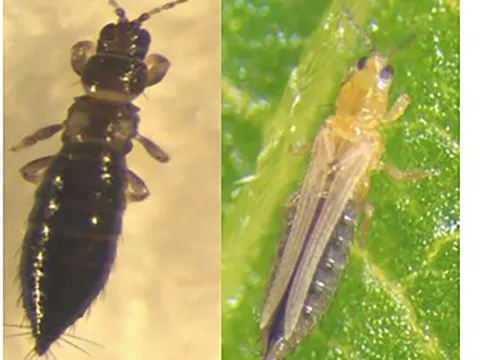
Peanut thrips
Enneothrips flavens
Peanut thrips (Enneothrips flavens) are small, slender insects belonging to the order Thysanoptera and the family Thripidae. They are known for their yellowish-brown body coloration and extremely small size, making them difficult to detect without magnification.
What the section contains
Peanut thrips
The life cycle of this pest consists of eggs, larvae, prepupae, pupae, and adults. The entire development process occurs on the host plant, often clustered within the terminal buds or the undersides of young leaves, which provides protection from environmental extremes.
These insects thrive in warm and humid conditions, which allow for rapid generation cycling. In favorable tropical or subtropical environments, they can remain active throughout the entire growing season, creating continuous pressure on the crop.
Identification is based on morphological characteristics such as wing vein structure and mouthparts adapted for piercing and sucking. In the field, their presence is often identified by the combination of their specific feeding behavior and the resulting damage to the plant tissue.
Due to their mobility, thrips can spread quickly across a field. Their ability to reproduce parthenogenetically under certain conditions significantly increases their population density in a very short time, posing a persistent threat to farmers.
The primary host for Enneothrips flavens is the cultivated peanut (Arachis hypogaea). By feeding on the sap of young tissues, the insects deplete the plant's resources, which are crucial for early vegetative growth and subsequent pod development.
Beyond peanuts, this pest may also survive on alternative hosts within the Leguminosae family. These weeds serve as reservoirs for the pest, allowing it to survive between crop cycles and migrate onto new plantings.
The direct damage caused by piercing and sucking leads to the destruction of epidermal cells. This disruption interferes with photosynthesis and can cause severe physiological stress, resulting in stunted plants and reduced overall biomass.
Enneothrips flavens is also a significant vector for several viral diseases. The transmission of these viruses often causes more severe economic losses than the direct feeding damage, as it can lead to total crop failure in sensitive varieties.
Economic impact is measured by a significant reduction in pod yield and quality. The damage to terminal shoots forces the plant to lose energy in regrowth, delaying maturity and making the crop more susceptible to other environmental stressors.
Early symptoms of an infestation include the curling and twisting of young, terminal leaves. Affected leaves often exhibit a bronzed or chlorotic appearance, reflecting the destruction of chlorophyll due to feeding activity.
Small, black spots, which are the excrement of the thrips, are usually visible on the underside of the leaves. This is a primary diagnostic sign confirming an active colony of insects is present on the plant.
Severe infestations lead to marked stunting and deformation of the foliage. The plants appear dwarf and unhealthy, with shortened internodes and a reduction in the number of leaflets, significantly altering the plant's architecture.
Silvery, streaked patches may appear on the leaf surface where cells have been emptied of their contents and filled with air. These streaks are characteristic of thrips feeding and are easily visible as the damage progresses.
In cases of high infestation, the terminal buds may turn brown and wither completely. If left unmanaged, the entire canopy of the peanut field will show reduced vigor, eventually leading to a measurable decline in total agricultural output.
Integrated Pest Management (IPM) is essential for controlling peanut thrips. This includes cultural practices such as destroying weeds in and around the field to eliminate alternate hosts and overwintering sites for the pest.
Crop rotation and proper field hygiene are foundational. Avoiding continuous peanut cultivation on the same land helps break the life cycle of the pest, making it harder for the population to establish a persistent presence.
Chemical control involves the use of systemic insecticides, particularly during the early stages of crop growth when the plants are most vulnerable. It is critical to rotate active ingredients to prevent the development of insecticide resistance.
Biological control, using natural predators like minute pirate bugs or predatory mites, can effectively suppress thrips populations in sustainable farming systems. This approach reduces the need for synthetic chemicals and fosters environmental balance.
Monitoring the fields using sticky traps is a crucial step in decision-making. By tracking the population density, farmers can apply treatments only when necessary, ensuring the economic viability of the farm while protecting the yield.