
Pear thrips
Taeniothrips inconsequens
Description
How to identify
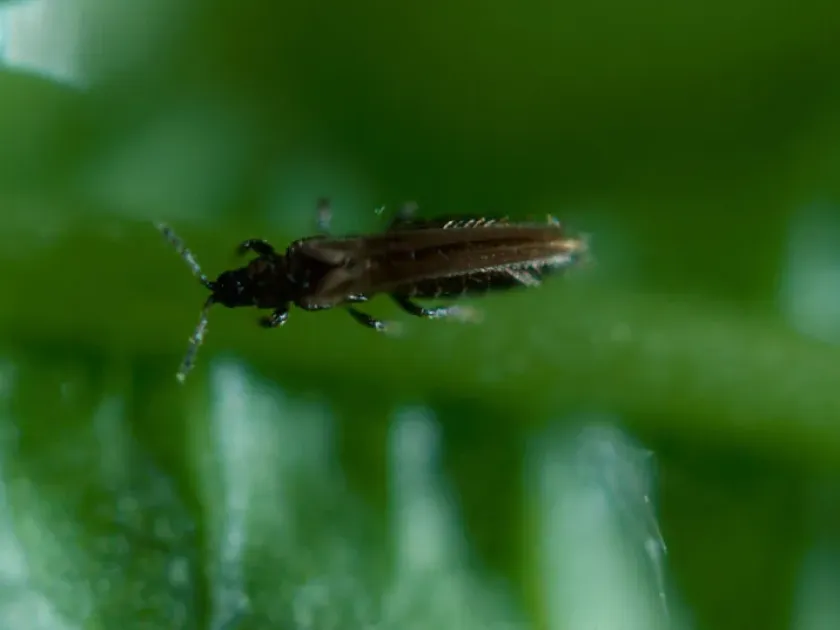
The pear thrips (Taeniothrips inconsequens) belongs to the Thripidae family within the order Thysanoptera. These are tiny, slender insects measuring approximately 1.5 mm in length, typically dark brown or black in color.
Adult thrips possess two pairs of long, narrow wings fringed with hairs, which are characteristic of this order. Larvae are much smaller, wingless, and usually appear pale yellow or whitish, often hiding in crevices.
The life cycle encompasses several stages: egg, larva, prepupa, pupa, and adult. Notably, the pupal stages often occur in the soil, making them elusive targets for conventional foliar spray applications.
They overwinter as adults or advanced larvae in the soil beneath the canopy of host trees at depths ranging from 15 to 30 centimeters. Emergence occurs in early spring as soil temperatures begin to rise.
Reproduction is largely parthenogenetic, meaning females can produce offspring without mating. This reproductive strategy allows for rapid population explosions within a single growing season under favorable weather conditions.
What it damages
Pear thrips primarily attack members of the Rosaceae family. While the pear tree is the namesake host, they also cause significant economic damage to apple, plum, cherry, and various deciduous forest species.
The insects feed by piercing the plant tissue and sucking the sap. They target the most vulnerable parts of the plant, including developing buds, young tender leaves, and swelling flower clusters.
Damage to the buds prevents them from opening properly, causing them to turn brown and wither. This condition, often referred to as 'blasted' buds, can drastically reduce the potential fruit set.
Leaves that manage to emerge show signs of crinkling, curling, and distortion. Furthermore, the presence of necrotic spots on foliage reduces the plant's ability to photosynthesize, weakening the tree's health.
Severe infestations often result in the dropping of young fruitlets, leaving the tree with little to no yield. Scars and deformities on the skin of surviving fruits are common consequences of early-season feeding.
Signs of infestation
The most prominent sign is the delayed or stunted development of buds in early spring. If buds are opened manually, one might find the small, dark adult insects active within the protected scales.
Foliage damage appears as silvery or metallic stippling on the leaves. As the insect extracts the contents of plant cells, the empty air-filled cells cause this specific light-reflecting appearance.
Premature leaf drop and the presence of distorted, shriveled leaves are clear indicators of a heavy infestation. The overall canopy may look sparse and sickly compared to healthy, uninfested trees.
One can detect the presence of thrips by observing the small, black, shiny fecal droplets left on the underside of leaves and on the fruit. These spots are a definitive sign of active insect feeding.
Shaking branches over a sheet of white paper is an effective diagnostic method. The dislodged insects appear as tiny, dark, fast-moving slivers, which confirms their presence in the canopy.
Control measures
Cultural control is a cornerstone of management. Cultivating the soil in the autumn under the canopy can expose overwintering pupae to the elements, leading to increased mortality during cold weather.
Blue sticky traps are highly recommended for monitoring purposes. They help in determining the exact timing of adult emergence, which is crucial for scheduling potential insecticide applications effectively.
Chemical control should be applied judiciously, focusing on the period just before or after the bloom. Systemic insecticides are generally the most effective against this pest due to their ability to reach protected areas.
Biological control methods include the application of entomopathogenic fungi to the soil. These beneficial fungi target the pupal stage of the thrips, reducing the overwintering population for the next season.
To prevent resistance, it is vital to rotate different classes of insecticides. Always ensure that applications are performed outside of blooming hours to protect pollinators such as honeybees.
Taxonomy
- Latin name
- Taeniothrips inconsequens
- Order
- Thrips
- Family
- Thripidae
- EPPO code
- TAETIN
Discussion
No discussions yet — be the first.