
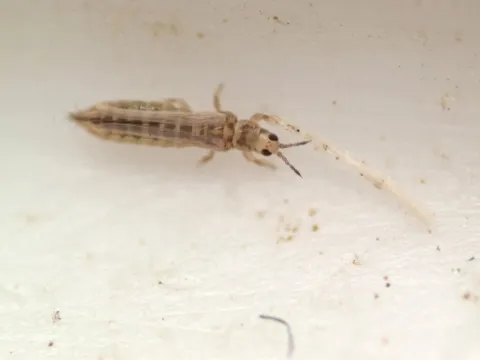
Barley thrips
Anaphothrips obscurus
The barley thrips (Anaphothrips obscurus) is a small insect belonging to the order Thysanoptera and the family Thripidae. These pests are approximately 1–1.5 mm long, with a slender body that ranges from light yellow to dark brown in color.
What the section contains
Barley thrips
Adults typically have two pairs of narrow, fringed wings, although short-winged or wingless individuals are frequently encountered. The head features piercing-sucking mouthparts, specifically adapted for feeding on plant cell contents.
The nymphs resemble the adults in appearance but are smaller and lack developed wings. They are usually paler, often translucent or yellowish, making them difficult to spot on the foliage surface during early infestation stages.
They overwinter as adults in plant debris, soil crevices, or dry grass along field borders. As soon as temperatures rise in the spring, they migrate to young, succulent vegetation to begin their reproductive cycle.
Reproduction can occur through both sexual mating and parthenogenesis. Females insert their eggs into plant tissues using a saw-like ovipositor, which protects the eggs from environmental stressors and predators.
The barley thrips is a significant pest of various cereal crops, including wheat, barley, oats, rye, and millet. It also thrives on a wide range of wild grasses, such as timothy and couch grass, which serve as alternative hosts.
By feeding on the cell sap, they cause physiological stress to the plant. This feeding process results in the destruction of plant cells, which reduces the plant's ability to perform photosynthesis and hinders overall growth.
During the heading stage, heavy infestations can cause the spikelets to turn white or blotchy. This leads to poor grain filling, resulting in shriveled kernels and significant reductions in total crop yield and quality.
Under dry and hot weather conditions, the damage becomes even more severe as the plants lack the vigor to compensate for the lost sap. This makes the crop increasingly susceptible to secondary infections and environmental stress.
Beyond direct feeding damage, these thrips are documented vectors for several plant viruses. Their feeding wounds provide an entry point for pathogens, which can lead to widespread disease outbreaks within a field.
Activity begins in early spring as soon as ambient temperatures consistently reach 10–12 degrees Celsius. Initially, populations are concentrated on weed grasses before they move into adjacent cultivated fields.
The population density peaks during the stem elongation and heading phases of cereals. During this time, favorable weather conditions allow for rapid succession of multiple generations within a short period.
Depending on the local climate, these insects can complete three to seven generations per season. In optimal temperatures of 20–25 degrees Celsius, a single generation cycle can be completed in just two to three weeks.
Mid-summer heat can drive the migration of adults to new, greener fields via wind currents. A dry summer typically increases the reproduction rate, leading to rapid colonization of neighboring agricultural areas.
As the season ends and crops are harvested, the thrips move into dormancy. They aggregate in the soil, around the base of perennial grasses, or within the litter layer to endure the winter months until the next season.
Early symptoms appear as light, silvery, or whitish streaks on the leaves. These spots are caused by the destruction of epidermal cells and the subsequent loss of chlorophyll, giving the foliage a mottled appearance.
As the infestation progresses, leaves may curl, turn yellow, and wither prematurely. The plants appear stunted and weak, and in severe cases, the entire field can show signs of significant vigor loss and thinning.
Damaged spikes often exhibit distinctive white patches or general discoloration. Grains fail to mature properly, resulting in a lower test weight and poor kernel development at harvest time.
- Appearance of silver or white streaks on leaf blades.
- Curling and deformation of young leaves.
- Whitening or mottling of spikelets (white ears).
- Presence of black frass (excrement) on the underside of leaves.
- Stunted growth and delayed phenological stages.
To confirm the presence of barley thrips, inspect the leaf sheaths and the undersides of foliage using a hand lens. Finding both the adults and the yellowish nymphs confirms the presence of an active colony.
Effective management begins with robust agronomic practices, such as crop rotation and the destruction of grassy weeds. Eliminating reservoir hosts like couch grass around field edges is crucial for reducing early spring migration.
Deep plowing in the autumn helps to bury plant residues where the thrips overwinter, effectively reducing the carry-over population for the following year. Consistent field sanitation is essential for limiting potential outbreaks.
If economic thresholds are reached, chemical intervention using registered insecticides is necessary. Effective compounds often include pyrethroids or neonicotinoids applied during the early stages of nymph development.
Applying insecticides during the early morning or evening hours improves efficacy as the insects are more exposed and active. Rotating chemical classes is vital to prevent the development of resistance within the population.
Integrated Pest Management (IPM) also encourages the preservation of natural predators, such as lacewings and predatory bugs. Balancing chemical control with biological support helps maintain sustainable population levels over the long term.