
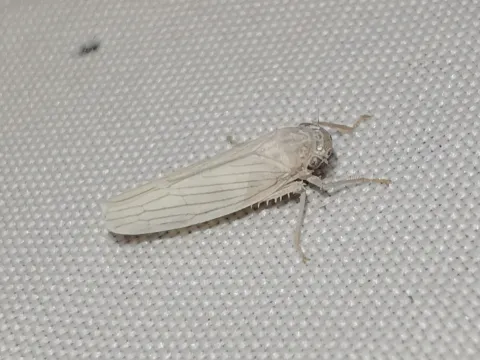
White leafhopper
Tettigella spectra
The white leafhopper (Tettigella spectra) is a member of the Cicadellidae family, known for its significant impact on rice cultivation. These insects are easily identifiable by their slender, creamy-white bodies.
What the section contains
White leafhopper
Adult leafhoppers measure approximately 7–9 mm in length. Their head is broad, and a distinctive feature is the presence of two or more black spots on the vertex, which helps distinguish them from similar species.
Their wings are transparent or slightly opaque, resting in a roof-like position over the body. They are highly agile and jump rapidly when disturbed, making them difficult to capture manually.
The nymphs go through five instars. They are smaller than adults and lack fully developed wings but possess the same piercing-sucking mouthparts, enabling them to cause damage from the earliest stages.
These insects thrive in environments with high humidity and stagnant water, which are the primary habitats for irrigated rice crops. They are particularly abundant in tropical and subtropical regions.
Rice (Oryza sativa) is the main host plant. The white leafhopper feeds on the sap of the plant by inserting its stylets into the leaves and stems, which disrupts the plant's vascular system.
Direct damage involves the removal of nutrients, which leads to stunted growth, reduced tillering, and lower grain yield. The leaves lose their green color and eventually turn yellow due to the destruction of chlorophyll.
Indirect damage is perhaps more critical, as this species is a vector for several phytoplasma diseases, such as rice orange leaf and yellow dwarf, which can be devastating to yield.
Feeding sites on the leaves often become necrotic or dry out. When populations are high, the entire field can appear chlorotic, signaling a severe infestation that requires immediate attention.
In addition to rice, the pest can survive on various wild grasses found on the fringes of fields, allowing it to persist throughout the year if conditions remain favorable.
The life cycle of the white leafhopper is temperature-dependent. In optimal conditions, the insect completes its development quickly, leading to multiple overlapping generations within a single growing season.
Eggs are typically inserted into the plant tissue, such as leaf sheaths or blades, protecting them from environmental stress and some topical pesticide applications.
The peak infestation period usually coincides with the vegetative stage of the rice crop. As plants mature, the population may stabilize, but the damage sustained during the early stages often persists.
Climate factors play a huge role in their population dynamics. Warm and humid weather significantly shortens the development cycle, leading to sudden population outbreaks.
During the off-season or harvest time, the leafhoppers migrate to alternative hosts. This migratory behavior makes it essential to manage weed populations around the paddy fields.
The most obvious sign of infestation is the sudden flight of numerous small white insects when walking through a rice field. They typically jump or fly in short bursts when disturbed.
Yellowing of leaves, starting from the tips or margins, is a key indicator of sap-sucking activity. As feeding progresses, these yellow areas expand, leading to the browning of leaf tissues.
Black sooty mold growth on the leaves is another common indicator. This fungus thrives on the honeydew excreted by the leafhoppers during their intensive feeding periods.
Plants affected by diseases transmitted by the leafhopper show specific symptoms, such as premature yellowing, stunted appearance, and failure to produce healthy panicles.
Patches of withered or chlorotic rice plants within the field are a strong warning sign of a localized, heavy infestation that can quickly spread across the entire planting area.
Integrated Pest Management (IPM) is essential for controlling Tettigella spectra. This includes cultural practices such as removing weed hosts and maintaining clean field boundaries.
Balanced fertilizer application is crucial, as excessive nitrogen levels promote succulent vegetative growth that is highly attractive to leafhopper populations.
Conservation of natural enemies is a primary focus of biological control. Predatory bugs, spiders, and parasitoid wasps significantly reduce leafhopper numbers if their habitat is protected.
Chemical control should be applied judiciously, only when the economic threshold of damage is reached. Systemic insecticides are generally effective but should be used to minimize impact on beneficial insects.
- Use of light traps for monitoring population levels
- Planting resistant or tolerant rice varieties
- Implementing regular field scouting to detect early outbreaks
- Adjusting irrigation to avoid stress-related susceptibility