
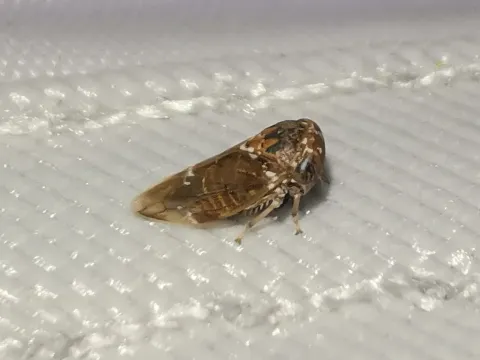
Willow leafhopper
Idiocerus nitidulus
The willow leafhopper (Idiocerus nitidulus) is an insect belonging to the family Cicadellidae, order Hemiptera, known for its wedge-shaped body.
What the section contains
Willow leafhopper
Adult insects typically measure between 5 and 6 mm in length, possessing a robust build that allows for quick jumping and active flight.
Their coloration is generally a mix of dull gray, brown, and ochre, providing effective camouflage against the bark of host trees.
Nymphs resemble smaller, wingless versions of adults and are typically found on the undersides of leaves, where they move with surprising agility.
The specific structure of the head and the orientation of the eyes are diagnostic features used by entomologists to distinguish this species from other related leafhoppers.
Willow species (Salix spp.) are the primary hosts for this pest, though they can occasionally be found on poplar trees in urban landscapes.
Feeding occurs via a piercing-sucking mouthpart, which extracts essential nutrients and water from the plant tissue of leaves and young stems.
Heavy infestations can cause significant stress to host plants, leading to a reduction in growth vigor and overall tree health in parks and nurseries.
In addition to direct physiological damage, the leafhoppers can act as vectors for various plant pathogens, potentially leading to more severe tree diseases.
Severe attacks often manifest as premature defoliation, which detracts from the aesthetic value of the trees and reduces their ability to photosynthesize.
The species survives the winter stage as eggs, which are deposited underneath the bark of younger twigs during the late autumn period.
Egg hatching usually aligns with the bud-break phenology of the willow, ensuring that nymphs have immediate access to fresh, nutrient-rich plant tissue.
Depending on the climatic zone, the willow leafhopper may complete one or two generations per year, with adult populations peaking during the summer.
As summer temperatures rise, the mobility of adults increases, leading to the colonization of new foliage and neighboring host trees.
The life cycle concludes with the final generation of adults laying their overwintering eggs, ensuring the persistence of the population for the next year.
Early symptoms include the appearance of small, pale, or whitish spots on the leaf surface, which correspond to the locations where the insects have fed.
As the infestation progresses, leaves may turn yellow, curl at the margins, and show signs of necrosis, leading to stunted shoot growth.
The presence of honeydew on the leaves is a common indicator, often followed by the development of black sooty mold that covers the leaf surface.
Physical disturbance of the branches usually triggers a mass departure of adult leafhoppers, which is a reliable field test for verifying their presence.
Overall decline in crown density and distorted growth of new shoots are secondary signs indicating that the infestation has reached a critical level.
Sanitation practices such as pruning and destroying heavily infested branches are effective in reducing the overall population density of the pest.
Maintaining tree vigor through proper irrigation and fertilization enhances the natural defenses of the plants against sucking insects.
Chemical control is most effective when applied during the early stages of nymphal development before the population spreads throughout the canopy.
Systemic insecticides are the preferred choice for large-scale infestations, as they protect the plant from within and minimize contact with non-target organisms.
- Deployment of sticky yellow traps for population monitoring.
- Preservation of predatory insects like lacewings and ladybirds.
- Regular field scouting during spring months to detect early hatching.