
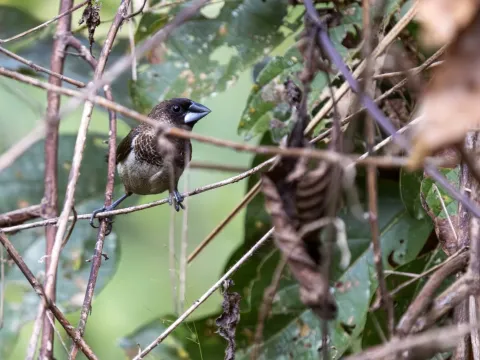
White-rumped munia
Lonchura striata
The white-rumped munia (Lonchura striata) is a small passerine bird in the estrildid finch family. Measuring approximately 10–12 cm in length, it features a pointed tail and a stout, conical bill adapted for husking seeds.
What the section contains
White-rumped munia
Its plumage is typically dark brown on the upperparts with white or pale streaks, while the underparts are lighter, often whitish. The contrast between the dark wings and the white rump is a diagnostic feature used to identify the species in the field.
These birds are highly social and are frequently observed in flocks. This group behavior is a significant factor in their status as agricultural pests, as a single flock can quickly cause substantial damage to ripening grain.
Breeding is opportunistic and can occur throughout the year given favorable conditions. Nests are usually constructed in trees or dense bushes near open fields, providing both camouflage and proximity to food sources.
Originating from Asia, they have adapted successfully to agricultural landscapes. Their presence is most prominent in rural areas where rice cultivation provides a consistent and abundant food supply.
The white-rumped munia primarily targets cereal crops, with rice being the most affected. They feed on grains during the milk and dough stages, causing significant yield losses in affected fields.
Besides rice, they are known to feed on millet, sorghum, and other small-seeded grasses. The damage is often widespread, as birds consume grains directly from the panicles or ears of the plants.
A key aspect of their damage is the physical destruction of the crop. Birds often perch on the stems, causing them to bend or break, which not only makes the grain inaccessible to harvesters but also leaves it prone to rot.
Direct consumption is compounded by the birds' practice of dropping large amounts of husks and half-eaten grains on the ground. This behavior leads to secondary losses and decreases the overall quality of the harvested crop.
Furthermore, the presence of flocks on a field promotes the accumulation of feces, which can introduce pathogens and spoil the surrounding grains, rendering the affected areas unsuitable for consumption or commercial sale.
The threat from the white-rumped munia is seasonal, aligning with the maturation phases of the grain. Farmers notice increased bird activity as the crop enters the grain-filling stage.
Local migrations often occur as birds follow the availability of food across different landscapes. Large flocks arrive in agricultural areas exactly when the grain becomes palatable, suggesting high spatial awareness.
Peak feeding times are during the early morning and late afternoon. During the heat of the day, birds usually retreat to shaded areas such as nearby trees or scrubland, awaiting the next feeding window.
Climatic factors play a role in their activity; in drought years, bird pressure on irrigated rice fields intensifies because these fields become the primary source of water and nutrition in the area.
Monitoring for the presence of these birds should begin at least two to three weeks before the estimated harvest date to ensure that protective measures are implemented on time.
The primary sign of infestation is the presence of hollowed-out or empty panicles where seeds have been consumed. Broken stalks and bent plants are also clear indicators of a visiting flock.
Accumulations of grain husks and debris on the soil surface under the crop canopy suggest that a flock has been feeding in the immediate vicinity for an extended duration.
The birds themselves are noisy, and the sound of a large flock taking flight or moving between rows is a recognizable indicator of their current presence on the farm.
Additionally, the presence of guano deposits on the leaves of the plants is a visual sign that the birds have been utilizing the crop as a regular feeding and resting area.
- Empty or partially eaten grain panicles
- Scattered husks on the ground
- Bent or broken crop stalks
- Presence of bird droppings on foliage
Effective management of the white-rumped munia relies on a combination of deterrent strategies. Loud acoustic deterrents, such as propane cannons or pre-recorded alarm calls, can be effective if used intermittently.
Visual repellents, including flash tapes and scarecrows representing birds of prey, should be moved frequently. If left in one position, birds quickly habituate to the devices and ignore them.
On a smaller scale, covering crops with protective nets is the most reliable way to prevent access. However, this is rarely feasible for commercial-sized rice or grain operations.
The most important agricultural practice is synchronized and rapid harvesting. Reducing the length of time that the grain remains in the field significantly limits the potential for damage.
Managing the area around the field is also crucial. Removing tall weeds and pruning dense bushes along field boundaries reduces the number of perching sites, making the area less hospitable for the flocks.