
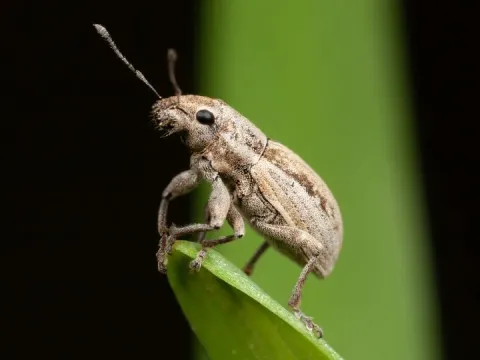
White-fringed beetle
Graphognathus
The white-fringed beetle (Graphognathus spp.) is a member of the Curculionidae family. Adult beetles are approximately 10–12 mm long, characterized by their greyish-brown body and a distinct white band along the edges of their elytra.
What the section contains
White-fringed beetle
A critical biological feature of this species is its flightlessness. Since the beetles cannot fly, they rely on crawling and, more importantly, human-assisted movement via soil, machinery, and agricultural products to spread to new areas.
The adult body is covered in fine scales, giving it a dull appearance. The snout is relatively short and broad compared to other weevils, and the mouthparts are well-adapted for feeding on leaf margins.
Larvae are legless, C-shaped, and creamy-white with robust, dark-colored mandibles. They spend their entire developmental phase feeding within the soil profile.
Reproduction is exclusively parthenogenetic, meaning a single female can establish a new infestation without the need for mating, making it a highly persistent invasive species.
The white-fringed beetle is a polyphagous pest, known to feed on more than 300 different plant species, including major crops like soybeans, alfalfa, peanuts, and various vegetable crops.
Larval feeding is the most destructive phase. The larvae consume roots, root hairs, and the crown of the plant, which often leads to total crop failure, stunted growth, or decreased yields.
Adult beetles feed on the foliage of host plants, causing characteristic semi-circular notches along the leaf edges. While this rarely kills established plants, it reduces photosynthetic capacity.
The root damage caused by larvae facilitates entry for secondary pathogens, such as soil-borne fungi and bacteria, leading to further decay and decline of the crop health.
Infestations are often patchy, but in highly favorable conditions, the larvae can decimate entire fields of legumes or vegetable crops within a single season.
Adult beetles are typically active during the summer months, usually appearing from June through September. During this time, they feed on foliage and lay eggs on plant parts or on the soil surface.
After hatching, the larvae move downward into the soil, where they spend the majority of their lifecycle. They can survive at various depths, depending on moisture levels and temperature.
The species primarily overwinters as larvae deep in the soil, which protects them from extreme winter cold and makes them highly resilient in temperate climates.
The life cycle duration can vary from one to two years, depending on environmental factors. This long developmental period makes forecasting and chemical control timing quite complex.
Pupation takes place in the soil, usually in the spring, leading to the emergence of new adults. This cycle can overlap, meaning adults of different ages may be present simultaneously in the field.
The most visible sign of an adult infestation is the characteristic notched, ragged edges of the leaves, frequently observed in the morning or evening when beetles are more active.
Signs of larval infestation include the sudden wilting of plants, yellowing leaves, and stunted development that cannot be attributed to water or nutrient deficiency.
When digging up the soil around an affected plant, one may find the white, C-shaped larvae directly attached to the primary root or root crown.
In severe cases, plants may exhibit signs of lodging as their root systems are destroyed, making them unable to anchor effectively in the soil.
Egg masses are often deposited in clumps, protected by a sticky secretion on the lower surfaces of leaves or near the base of the plant stem, which is a key indicator for scouts.
Quarantine and phytosanitary measures are the most critical components of management to prevent the spread of the beetle to uninfested areas through nursery stock and soil movement.
Deep tillage is a recommended cultural practice to disrupt the larval population in the soil, exposing them to environmental stress and natural predators.
Chemical control is focused on the adult stage, utilizing contact insecticides applied to foliage. Timing is crucial and should coincide with peak adult activity periods.
Biological control options, including the use of entomopathogenic nematodes, have shown promise in suppressing larval populations in high-value vegetable fields.
- Implementing strict crop rotation schedules.
- Sanitizing farm machinery before moving between fields.
- Regular field scouting to identify patches of damaged plants.