
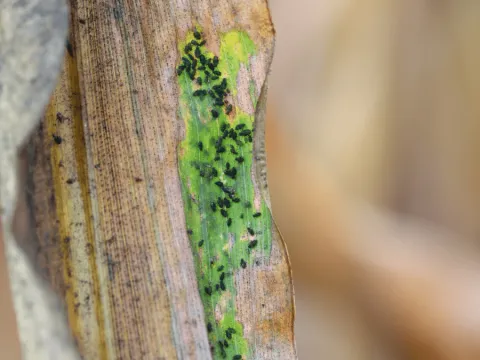
Grain aphid
Rhopalosiphum splendens
The grain aphid (Rhopalosiphum splendens) is a small insect belonging to the order Hemiptera and the family Aphididae, commonly found in agricultural landscapes.
What the section contains
Grain aphid
Adult aphids are typically oval-shaped, measuring approximately 2–2.5 mm in length, with body colors ranging from light green to olive or brownish tones.
The species exhibits polymorphism, with both winged and wingless forms, allowing them to rapidly colonize new crop fields during the active growing season.
They undergo a complex life cycle, reproducing rapidly through both asexual and sexual processes depending on environmental cues and temperature.
Overwintering usually occurs in the egg stage on the base of grasses or crop residues, providing a source for spring infestation as temperatures rise.
This pest primarily infests cereal crops such as wheat, barley, rye, and oats, as well as various wild grass species that serve as alternate hosts.
Aphids feed by inserting their piercing-sucking mouthparts into plant tissues, primarily targeting the undersides of leaves and the developing ears of the plant.
The extraction of phloem sap leads to significant nutrient loss, which stunts plant growth, reduces tillering, and negatively impacts grain filling.
Beyond direct damage, these insects are efficient vectors for several plant viruses, such as barley yellow dwarf virus, which can devastate crop yields.
Heavy infestations weaken the plant's structural integrity, making it more susceptible to environmental stress and secondary fungal infections.
The first signs of an infestation include the curling and yellowing of leaves, accompanied by a sticky residue known as honeydew on the leaf surface.
The presence of honeydew often encourages the growth of sooty mold, which appears as a black coating, further interfering with the plant's photosynthesis.
Infected crops often show signs of stunted growth, premature drying of the leaves, and the formation of shriveled or lightweight grain kernels.
Farmers can identify aphids by inspecting the lower leaf surfaces and the base of the stalks, where large clusters of the insects tend to congregate.
As the aphid population grows, the visual impact on the field becomes more apparent through localized patches of distressed and off-color vegetation.
Cultural control measures include effective weed management in and around fields to eliminate alternative hosts that support aphid populations off-season.
Optimizing planting dates and ensuring healthy crop development through proper fertilization helps plants better withstand the pressure from aphid feeding.
When the economic threshold is exceeded, chemical control using systemic insecticides is necessary to prevent significant yield losses during critical growth stages.
Maintaining the ecological balance by encouraging natural predators such as lady beetles, lacewings, and parasitic wasps is a key component of sustainable management.
Regular field scouting throughout the growth stages, especially during the boot and heading phases, is essential for timely detection and intervention.