
Grape phylloxera
Viteus vitifolii
Description
How to identify
Grape phylloxera is a microscopic aphid-like insect belonging to the family Phylloxeridae. It is a major pest that poses a severe threat to viticulture worldwide.
The insect exists in several forms, including root-dwelling, leaf-dwelling, and winged sexual forms, each having a distinct role in its complex life cycle.
Adults are typically yellow-green or brownish and measure about 1 millimeter in length, making them difficult to spot with the naked eye in the field.
It reproduces both sexually and parthenogenetically, which contributes to its ability to build large populations rapidly under favorable conditions.
Accurate identification usually requires expert knowledge of the insect's morphology or molecular diagnostic techniques due to its small size and cryptic nature.
What it damages
Phylloxera feeds exclusively on Vitis species, with Vitis vinifera being particularly susceptible due to its lack of evolutionary resistance to the pest.
The root-dwelling form causes significant damage by creating galls on roots, which leads to secondary infections, root rot, and the death of the vine.
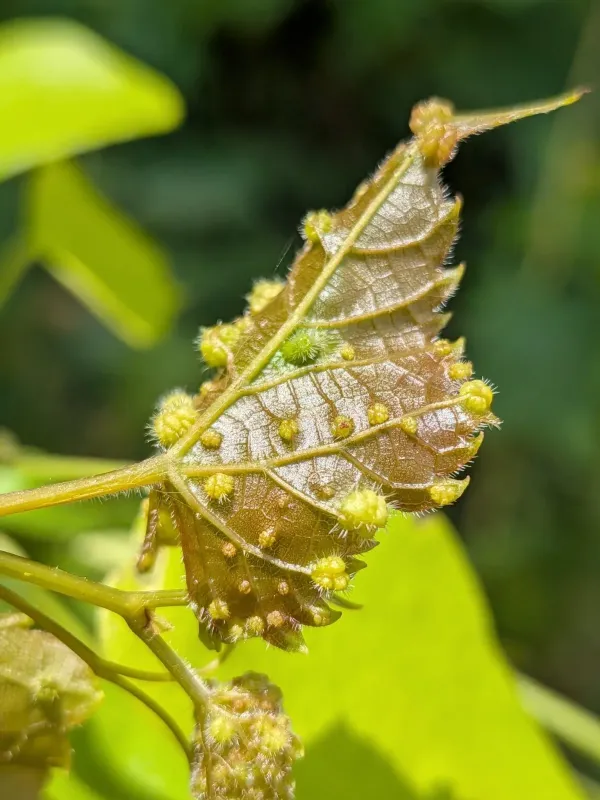
The leaf-dwelling form creates small galls on the undersides of leaves, which can reduce the photosynthetic area and impact the overall health of the plant.
Economic damage is severe, as an infestation can destroy an entire vineyard in a few years if no resistant rootstocks were used during planting.
The loss of vine vigor and the inability of the root system to absorb nutrients and water lead to a rapid decline in crop yield and fruit quality.
When it appears
The activity of phylloxera begins in early spring as soil temperatures rise, allowing the overwintering larvae to resume feeding on vine roots.
Several generations are produced throughout the growing season, with the highest population densities typically recorded during the summer months.
As the temperatures drop in late autumn, the insect enters a dormant state, primarily as first-instar nymphs on the root system.
The development rate and speed of spreading are highly influenced by environmental factors such as soil moisture, temperature, and vineyard management practices.
In regions with warm climates, the insect can remain active for a longer period, resulting in more generations and higher pressure on the vineyard.
Signs of infestation
Visual signs of an infestation include stunted growth of vines, chlorotic leaves, and a gradual decline in the overall vigor of the vineyard.
Upon closer inspection of the roots, one can find characteristic nodosities (small galls on young roots) or tuberosities (deformations on older roots).
Leaf galls, if present, appear as small, wart-like projections on the underside of leaves, which are often accompanied by early leaf drop in heavy infestations.
In many cases, the affected area in a vineyard expands over time in a characteristic pattern, reflecting the spread of the insect from the initial focal point.
Confirming an infection often requires digging up root samples and carefully inspecting them under magnification to detect the presence of the aphids.
Control measures
The primary and most effective control measure is the use of phylloxera-resistant rootstocks derived from native American Vitis species.
Strict quarantine protocols are essential to prevent the movement of contaminated nursery stock into clean, non-infested regions of the world.
Chemical control is generally ineffective against the root-dwelling form due to the pest's deep location in the soil and its protection within root galls.
Integrated Pest Management strategies emphasize the prevention of spread through equipment sanitation and the removal of infested vines to contain outbreaks.
Site selection and site preparation are crucial, as well-drained sandy soils are sometimes considered less favorable for the survival of the root-dwelling form.
Discussion
No discussions yet — be the first.