
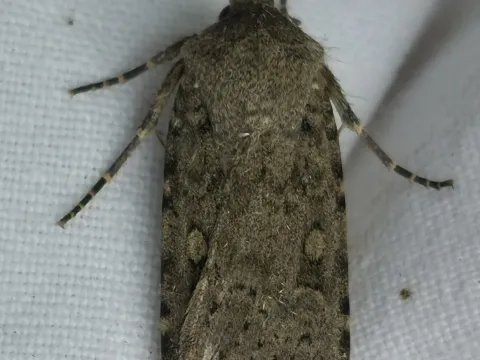
C-nigrum moth
Rhyacia c-nigrum
The adult moth has a wingspan of approximately 45 mm. The forewings display gray to brown shades with a distinctive light-colored mark resembling the letter 'C' or 'v', which serves as the most prominent identification feature for this species.
What the section contains
C-nigrum moth
The larvae, known as cutworms, grow up to 50 mm in length. Their body color ranges from gray to yellowish-brown, featuring dark oblique stripes or diamond-shaped markings on the dorsal side that taper towards the rear end of the body.
The pupa is dark brown with a glossy surface and measures about 20 mm in length. It possesses two terminal spines at the cremaster, which assist the insect in remaining securely fixed within the soil during the pupation period.
Taxonomically, the insect belongs to the family Noctuidae within the order Lepidoptera. It is a highly polyphagous pest capable of adapting to diverse environments, allowing it to colonize a wide range of agricultural landscapes effectively.
The life cycle involves complete metamorphosis, including egg, larva, pupa, and imago stages. In most temperate regions, the species completes two generations throughout a single growing season, often posing a persistent threat.
The C-nigrum moth is a destructive polyphagous pest that attacks a vast array of crops. Primary hosts include cereal grains, maize, sunflower, sugar beet, and various leguminous vegetables, making it a generalist threat.
Younger larvae cause damage by skeletonizing the leaf surface, creating irregular holes. Older larvae are capable of consuming entire leaf blades, leaving only the primary veins, which significantly impairs the photosynthetic capacity of the plant.
This pest poses a severe threat to vegetable gardens, particularly cabbage, tomatoes, and potatoes. Under high population densities, larvae may feed on stems and root collars, leading to the wilting and eventual death of young plants.
Damage to generative organs is particularly detrimental to production. In cereal crops, larvae may consume grains within the ear, while in row crops, they may feed on flowers and developing corn ears, reducing the total yield.
The economic impact is largely driven by the population density and environmental suitability. In years of outbreak, crop loss can reach significant levels, necessitating proactive monitoring and timely intervention to mitigate financial damage.
The flight of the first-generation moths typically begins in late spring, around May, and extends throughout June. Adults are nocturnal, feeding on floral nectar to gain the energy required for mating and dispersal.
Eggs are deposited on the underside of leaves of host plants or weeds. Embryonic development usually occurs over a period of 5 to 10 days, depending heavily on the prevailing ambient temperature and humidity levels.
Larvae emerge in early summer and engage in intense feeding for about a month. During this stage, they progress through several instars, with each subsequent stage requiring an increased volume of plant material for growth.
Pupation takes place in the soil at a depth of 3 to 5 cm. A second generation of moths emerges in late summer, initiating a new life cycle where the offspring often overwinter in the soil or under organic debris as larvae or pupae.
Meteorological conditions significantly influence the population dynamics. Moderate temperatures and adequate rainfall during the spring promote the survival of eggs and neonate larvae, potentially leading to increased infestations later in the summer.
Early symptoms of infestation include the appearance of irregular holes or 'window-paning' on foliage. Close inspection of the leaf underside often reveals egg clusters or small, recently emerged larvae actively feeding.
The presence of larval frass (excrement) on the soil surface or plant leaves is a strong indicator of an active infestation. Monitoring at night can reveal the larvae, as they are most active during the hours of darkness.
Wilting of individual plants that appears unrelated to moisture levels often indicates that older larvae have been feeding on the root collar or stems, disrupting the plant's vascular system and water transport.
Rolled leaves or fine silk threads may also suggest the presence of larvae using these structures as daytime refuges. Using light traps or pheromone traps is an effective way to track moth activity and population peaks.
- Foliage damage and skeletonization
- Accumulation of larval frass
- Unexplained plant wilting
- Capture of adults in monitoring traps
Cultural control is the cornerstone of management. Proper crop rotation and aggressive weed management significantly reduce the availability of host plants and disrupt the life cycle of the pest within the field.
Chemical control using insecticides is most effective when targeted at young larvae. It is essential to apply treatments according to local guidelines, focusing on stages where the pest is most vulnerable to the chemical agents.
Biological control options, such as using entomopathogenic bacteria or fungi, offer an environmentally sustainable alternative. These agents can be highly effective in suppressing populations without harming beneficial insect communities.
Promoting natural enemies, including parasitoid wasps and predatory beetles, plays a vital role in maintaining the balance of the ecosystem. Minimizing the use of broad-spectrum pesticides ensures the survival of these beneficial species.
Decision-making for control measures should rely on the economic threshold level (ETL), which varies by crop. A general guideline is to monitor for 1–2 larvae per square meter as a trigger for implementing protective intervention strategies.