
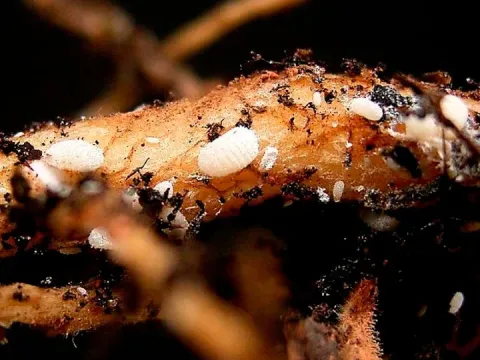
Root mealybug
Rhizoecus terrestris
The root mealybug (Rhizoecus terrestris) is a cryptic pest belonging to the Pseudococcidae family. Unlike other mealybug species, it spends its entire life cycle within the soil, feeding on roots.
What the section contains
Root mealybug
Adults are small, roughly 2–3 mm long, and have a white, waxy, mealy appearance. They often look like small white granules in the potting mix, which causes them to be mistaken for perlite or mineral deposits.
These insects are highly mobile in the soil profile. They prefer dry, aerated conditions and are commonly found in the root zone of plants growing in high-peat or sandy substrates.
They reproduce by laying eggs in small, white, fuzzy, cotton-like masses, which can often be found along the inner edges of the plant pot.
Their hidden nature allows them to thrive in greenhouses and nurseries, spreading easily through shared irrigation systems or contaminated soil batches.
The root mealybug causes significant damage to a variety of plants, including cacti, succulents, palms, African violets, and various tropical indoor plants.
By feeding on root sap, these insects deprive the plant of essential water and nutrients. This disruption leads to stunted growth, yellowing foliage, and eventual plant collapse.
The wounds left by the mealybugs serve as entry points for secondary fungal and bacterial infections, leading to root rot and irreversible tissue decay.
In high populations, the pests can destroy the fine, nutrient-absorbing root hairs, causing the plant to starve even if it is watered and fertilized regularly.
Young plants or newly propagated specimens are particularly vulnerable and may die quickly if the infestation is not detected and treated in time.
The most common sign of a root mealybug infestation is a sudden, unexplained decline in plant health, where the plant appears wilted or tired despite appropriate watering.
Upon removing the plant from its pot, you may see white, waxy secretions or cottony webs clinging to the roots and the sides of the container.
A crusty, white waxy deposit may also appear on the surface of the soil or around the base of the plant, often becoming more noticeable after the soil has dried out.
The plant growth will stop abruptly, and the leaves may start to drop or lose their glossy appearance, reflecting the compromised root system.
Often, if you notice an ant population hovering around your potted plants, it could be a secondary indicator, as ants are known to tend and protect mealybugs in the soil.
Effective control requires the use of systemic insecticides applied as a soil drench. These chemicals are taken up by the roots, making the plant tissues toxic to the pests.
If an infestation is confirmed, it is best to remove the plant from the pot, wash the roots thoroughly in an insecticidal solution, and repot it in fresh, sterile soil.
Be sure to discard the old potting mix and sanitize the pots and any tools used during the process to prevent re-infestation.
Quarantine all new plants for several weeks before introducing them to your home or greenhouse to ensure they are free from root-dwelling pests.
- Apply systemic insecticides as a soil drench.
- Repot plants in fresh, sterilized potting mix.
- Sanitize pots and tools thoroughly.
- Implement strict quarantine for new plants.