
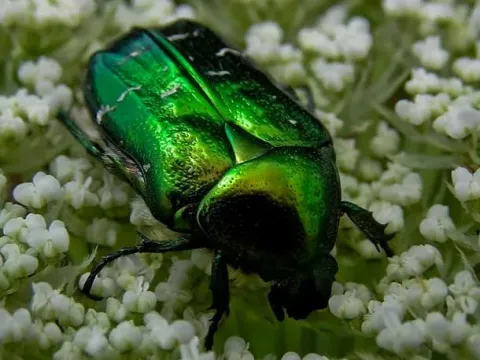
Rose chafer
Potosia speciosissima
The Rose chafer (Potosia speciosissima) belongs to the family Scarabaeidae, within the order Coleoptera. Adults are characterized by a vibrant metallic sheen, ranging from emerald green to coppery red.
What the section contains
Rose chafer
The beetle’s body is oval, measuring approximately 20–25 millimeters in length. A defining feature of this specific species is its smooth elytra, which lacks the prominent white spots found in other related species.
The larvae are large, C-shaped, and creamy white with a brownish head. They reside primarily in soil enriched with organic matter, compost heaps, or decaying wood.
The life cycle undergoes complete metamorphosis and typically lasts between two to three years, heavily influenced by regional climate and nutrient availability.
Adult beetles are highly active during warm, sunny days, performing flight activities to locate food sources and mates within the garden environment.
Adult beetles are considered garden pests because they feed on the generative parts of plants. They consume petals, stamens, and pistils, often destroying the entire flower.
Primary targets include fruit trees such as apple, pear, cherry, plum, and apricot. Extensive feeding by large populations can lead to a significant reduction in fruit yield.
In addition to fruit crops, these beetles frequently damage ornamental plants. Roses, peonies, and other large-flowered garden species are particularly susceptible to their grazing.
Conversely, the larvae are largely beneficial to the ecosystem, as they feed on dead plant debris, acting as primary decomposers that improve soil structure.
Economic damage is most severe during hot, dry springs when the synchronization between the emergence of adults and the flowering of crops leads to concentrated attacks.
The flight period for adults begins in late spring, typically in May, and continues through the summer until late August or early September.
Peak activity occurs during the warmest part of the day when beetles are actively browsing on flowers. As sunset approaches, they often hide within foliage or descend to the ground.
Following the mating phase, females deposit eggs in organic-rich substrates, such as compost bins, manure, or hollows of aging trees.
Overwintering occurs primarily at the larval stage within the soil, though some adults may survive in pupal cells until the following season.
The emergence of the adult population is temperature-dependent, usually triggered when soil temperatures rise consistently above 10–12 degrees Celsius.
The most evident sign of infestation is ragged, eaten-away edges on petals and hollowed-out centers of blossoms, causing the flowers to wilt prematurely.
During the flowering season, gardeners may observe the shiny beetles resting on blossoms. They are often found in groups, feeding intensely on the nectar-rich reproductive organs.
The presence of large beetles near compost piles or decaying woody debris indicates a nearby breeding site that may contribute to recurrent infestations.
A failure to set fruit despite a healthy bloom is a common secondary indicator that reproductive parts of the flowers were consumed by the beetles.
These beetles are highly skittish and will readily take flight upon detection of movement or changes in light, confirming their presence in the canopy.
The most practical non-chemical control method is manual collection in the early morning hours, as beetles are sluggish in cooler temperatures and drop easily when branches are shaken.
Chemical control during the flowering stage is highly discouraged, as most insecticides will kill beneficial pollinators like honeybees and bumblebees.
- Utilizing pheromone or light traps to reduce the population of active adults.
- Performing thorough autumn soil cultivation to expose and destroy overwintering larvae.
- Removing old stumps, rotting wood, and maintaining clean compost areas to eliminate larval habitats.
If chemical intervention is unavoidable, it must be performed strictly before the flowering begins, using selective pesticides according to label directions.
Encouraging garden biodiversity, specifically insectivorous birds and predatory insects, can help maintain natural equilibrium and suppress beetle numbers.