
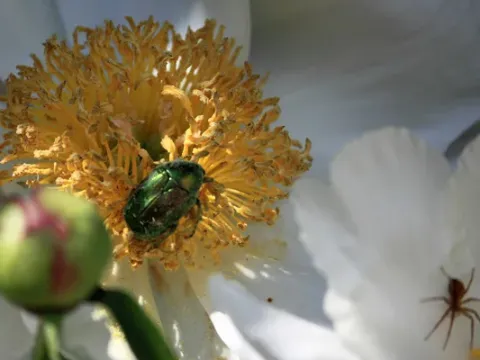
Rose chafer
Potosia floricola
The Rose chafer (scientific name Potosia cuprea, synonym Potosia floricola) belongs to the Scarabaeidae family. This beetle is easily recognized by its vibrant metallic sheen, ranging from emerald green to copper or violet.
What the section contains
Rose chafer
Adult beetles grow to about 15–23 mm in length. Their bodies have a distinctive triangular scutellum and white transverse markings on the elytra, which help distinguish them from other similar scarabs.
The larvae are large, C-shaped, and creamy-white with a small head. They reside primarily in decaying organic matter, compost piles, or rotting wood, performing a role as decomposers in the ecosystem.
The life cycle typically spans 2 to 3 years. Development occurs mostly underground or within organic substrates, with beetles emerging as adults once the weather becomes consistently warm and sunny.
Unlike many other beetles, the Rose chafer flies with its elytra closed, extending its wings from the sides. This makes their flight noisy and somewhat clumsy compared to other insects.
Adult beetles are significant pests of flowering plants. They feed on the flowers of fruit trees, including apples, pears, cherries, and plums, often consuming the reproductive parts like anthers and pistils.
Ornamental flowers such as roses, peonies, and dahlias are also frequent victims. By eating the centers of the blossoms, these beetles destroy the plant's aesthetic value and prevent successful pollination.
In cases of heavy infestation, Rose chafers can completely strip a tree of its blossoms, leading to a major reduction in fruit set and overall yield for the gardening season.
While adult damage is visible and significant, larvae rarely harm healthy plant roots. They focus on decomposing matter, making them generally beneficial to soil health unless they become too numerous.
The harm caused by these beetles is most concentrated during warm, sunny days when they are highly active, moving rapidly between blossoms to maximize their feeding on nectar-rich parts.
Adult beetles emerge in late spring, usually in May, when temperatures reach at least 20°C. This timing often aligns with the blooming period of many popular garden fruit trees and shrubs.
Their peak activity occurs throughout June and July. They are strictly diurnal and prefer bright, open sunlight, tending to remain dormant or hidden during overcast or rainy weather.
Egg-laying takes place throughout the summer months. Females seek out moist, nutrient-rich environments, such as compost heaps or piles of decaying leaves and wood, to ensure the next generation has adequate food.
Pupation occurs in late summer or early autumn. The larvae construct sturdy cocoons made of soil particles and excrement to survive the transition stage before the adult emergence the following year.
Overwintering is primarily done in the larval stage deep in the soil or within the organic matter where they developed, allowing them to wait out the cold months before resuming activity.
The most obvious sign of infestation is finding bright, metallic beetles sitting deep inside open flower buds or clusters of blossoms, especially on sunny mornings.
Visual damage to flowers is distinct: the centers are often missing or hollowed out, and the petals appear frayed, torn, or ragged around the edges due to the beetle's feeding behavior.
Affected flowers typically wilt and turn brown within a few days of being attacked. You may notice a lack of fruit development in clusters that were heavily visited by the beetles.
An abundance of large, white C-shaped larvae found while turning over compost or garden mulch is a strong indicator of a high population density for the upcoming season.
In mid-summer, a distinct buzzing sound originating from flowering trees in bright sunlight is a clear sign that a population of Rose chafers is active and feeding in your garden.
Hand-picking the beetles in the early morning is the most effective and eco-friendly control method. Because they are lethargic in the cool morning air, they are easy to knock into a container.
Cultural practices are essential; keep garden areas clean of decaying wood and ensure compost piles are covered or turned frequently to disrupt the larvae's habitat and prevent egg-laying.
Deep cultivation of the soil around trees in late autumn can expose larvae and pupae to predators and frost, effectively reducing the population before the next spring emergence.
Chemical control is generally discouraged during the flowering stage because these beetles share habitats with essential pollinators like honey bees, which would be harmed by indiscriminate spraying.
- Hand-picking adults in early morning.
- Regularly turning or covering compost piles.
- Autumn soil cultivation to expose larvae.
- Encouraging natural bird predators in the garden.