
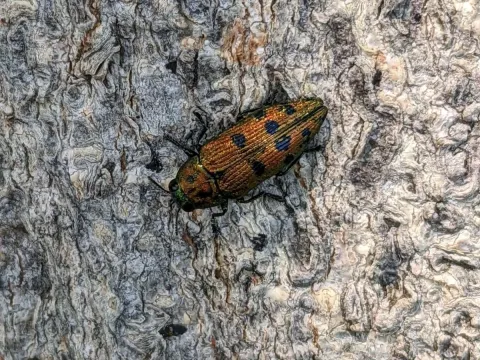
Masuda's flat-headed borer
Poecilonota masudai
Masuda's flat-headed borer (Poecilonota masudai) belongs to the Buprestidae family, known commonly as jewel beetles due to their iridescent, metallic coloration.
What the section contains
Masuda's flat-headed borer
Adult beetles are elongated, flattened insects typically ranging from 10 to 15 millimeters in length. They are well-adapted to blend into the bark of their host trees.
The larvae, which are responsible for the damage, are legless and have an enlarged thoracic segment, a classic morphology for flat-headed wood borers.
These insects are primarily cryptic, spending the vast majority of their life cycle hidden within the tree's vascular tissues, making them difficult to detect early.
Expert identification of this specific species requires careful examination of its morphological traits and host tree associations to differentiate it from other related buprestid beetles.
The primary hosts for Poecilonota masudai include various species of Populus (poplar) and Salix (willow), common in temperate forests.
While often categorized as secondary pests that prefer weakened or dying trees, large populations can significantly impact healthy, vigorous trees, accelerating their decline.
Larvae feed by excavating galleries in the phloem and cambium layers, which effectively disrupts the translocation of nutrients and water throughout the plant.
Over time, the cumulative damage caused by multiple generations of larvae results in girdling branches or even entire trunks, leading to limb dieback.
Infested trees often become highly susceptible to secondary attacks by pathogens and other wood-boring insects, which significantly reduces the tree's lifespan.
Adult beetles typically emerge in late spring or summer, coinciding with the period of peak foliage development in host trees.
The flight period is relatively short, during which the beetles feed on leaves and engage in mating rituals on the surface of the canopy.
Females deposit eggs in bark crevices, where newly hatched larvae immediately penetrate the bark to begin their tunnel excavation.
The development period of the larvae is lengthy and typically spans at least one full growing season, depending on the environmental conditions and host tree health.
Pupation occurs within the tree wood in late spring, after which the adults chew their way out, creating the characteristic exit holes used for species monitoring.
The most visible sign of infestation is the presence of small, distinct oval or D-shaped exit holes on the bark of the trunk and larger branches.
As larvae feed, they create meandering galleries beneath the bark, which can often be seen if the outer bark layer is stripped or damaged by wood-peckers.
- Accumulation of frass (boring dust) in bark fissures.
- Premature leaf yellowing or early autumn coloration of specific branches.
- Dieback of the upper canopy or individual limbs.
- Bark cracking or depressed areas on the trunk where feeding has occurred.
In cases of severe infestation, the bark may exhibit signs of necrosis, with darkened areas indicating where the larval galleries have disrupted tissue flow.
Sanitation is the cornerstone of managing Poecilonota masudai; this involves the prompt removal and disposal of infested trees to prevent the spread of emerging adults.
Promoting overall tree vigor through adequate irrigation and proper site selection is the best preventative measure against buprestid attacks in landscape settings.
While chemical control is challenging due to the hidden nature of larvae, systemic insecticides may be used as a preventative measure for high-value ornamental trees.
Encouraging natural predators, such as woodpeckers and parasitic wasps, can help suppress larval populations significantly within natural or forested environments.
Regular inspections, especially during the spring flight period, allow land managers to identify early signs of infestation and address the issue before significant tree damage occurs.