
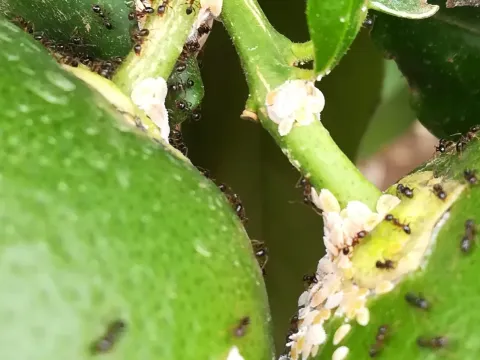
Mealybug Planococcus cryptus
Planococcus cryptus
The mealybug species Planococcus cryptus is a small insect belonging to the order Hemiptera, family Pseudococcidae. Adult females are oval-shaped and covered with a white waxy secretion that gives them a characteristic mealy appearance.
What the section contains
Mealybug Planococcus cryptus
The body of the pest is surrounded by short waxy filaments, and adult individuals typically measure between 2 and 4 millimeters in length. Males of this species are rarely observed, as they are winged and primarily focused on reproduction.
The larvae, known as crawlers, are highly mobile and display a pale yellow color without significant waxy coverage. This stage is critical for the dispersal of the pest across the host plant and to adjacent plants.
Species identification often requires laboratory analysis of morphological features, as it closely resembles other members of the genus Planococcus. Careful examination of waxy plate arrangement and pore structures is necessary for accurate diagnostics.
This species is a significant pest in subtropical and tropical regions, often entering greenhouses via imported plant material. Its cryptic habit of hiding in plant crevices makes early detection a challenge for growers.
This pest has a wide host range, including citrus, grapes, pomegranates, coffee trees, and various ornamental species. It feeds on plant sap by piercing the epidermis of young shoots, leaves, and fruit.
Feeding damage causes leaf deformation, yellowing, and premature abscission. Under heavy infestation, plants exhibit stunted growth, significant loss of fruit quality, and overall reduced yield.
While feeding, the mealybug excretes honeydew, a sticky substance that serves as a medium for the growth of sooty mold. This layer blocks photosynthesis, severely weakening the plant's natural immunity.
In some crops, Planococcus cryptus can penetrate deeply into inflorescences and fruits, making chemical control nearly impossible during the ripening stage. This creates a substantial economic burden for commercial farms.
The pest is also a potential vector for various plant viral diseases, which increases the risk of spreading pathogens throughout entire orchards or plantations, even when the pest population density is relatively low.
The first sign of infestation is the appearance of white, cotton-like wax deposits on the undersides of leaves, in stem axils, and along branches. These deposits contain eggs and female insects sheltered by wax.
Sticky residue on leaves and surrounding surfaces is a clear indication of honeydew secretion. Over time, this honeydew turns black due to the development of sooty mold, providing a highly visible marker of the infection.
Deformed terminal shoots and curled young leaves indicate intensive feeding activity. The host plant gradually appears weakened, loses turgor pressure, and develops an overall yellowish discoloration.
Massive clusters of the pest are often found in protected areas: under bark scales, at the attachment point between fruit and stems, and deep within the foliage where sunlight and air circulation are limited.
The presence of large numbers of ants, which feed on the honeydew produced by the mealybugs, is an indirect but reliable sign of active colonization and high pest pressure.
Managing Planococcus cryptus requires an integrated pest management (IPM) approach that combines cultural, biological, and chemical methods. Regular inspection of incoming plant shipments is essential for exclusion.
For localized infestations, manual removal using cotton swabs soaked in rubbing alcohol or mild soapy water can be effective. However, this is only practical for very small-scale infestations or individual plants.
Systemic insecticides containing active ingredients like imidacloprid, acetamiprid, or spirotetramat have shown high efficacy, as they are translocated within the plant sap to reach hidden populations.
Biological control strategies involve the release of natural predators, such as the mealybug destroyer beetle (Cryptolaemus montrouzieri) and various parasitoid wasps from the Encyrtidae family.
Maintaining optimal greenhouse humidity and strict sanitation is crucial. Remove plant debris and weeds that serve as reservoirs for the pest. Avoid excessive nitrogen fertilization, which promotes succulent, soft growth that is highly attractive to mealybugs.