
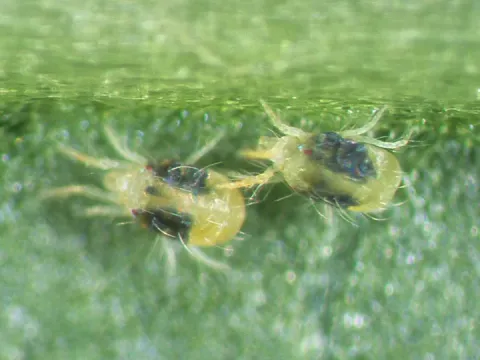
McDaniel spider mite
Eotetranychus macdanieli
The McDaniel spider mite (Eotetranychus macdanieli) belongs to the Tetranychidae family. These tiny arthropods measure approximately 0.4 mm and possess a yellowish-green to brownish body with distinct dark spots on their sides.
What the section contains
McDaniel spider mite
Identification often relies on the presence of fine webbing spun on the undersides of leaves, which serves as a refuge and a transit network for the mite colony. Without a microscope, distinguishing this species from other spider mites is challenging.
Fertilized females overwinter in a state of diapause, seeking shelter in tree bark crevices, leaf litter, or other protected locations. Once spring temperatures rise, they emerge to infest new foliage.
The biological cycle is extremely rapid; in favorable warm and dry weather, the mite can complete its life cycle in less than two weeks, leading to multiple generations throughout the growing season.
Colonies thrive primarily on the underside of leaves, moving to the upper side only after the leaf tissue has been severely damaged and the nutrient source is depleted.
This species is highly polyphagous and a significant pest of orchard fruit trees, including apples, pears, plums, and cherries. It also affects various small fruit bushes and ornamental plants.
By piercing the leaf surface and extracting cellular fluids, the mites cause severe damage to the chlorophyll-bearing tissues. This disrupts photosynthesis and significantly reduces the overall metabolic vigor of the host plant.
Heavy infestations lead to leaf necrosis, browning, and premature leaf drop. This foliage loss weakens the tree significantly, reducing its winter hardiness and its potential for fruit bud development in the following season.
Fruit quality is often compromised, as the mite feeding can cause russeting or discoloration on the fruit surface, drastically reducing marketability in commercial settings.
Young trees are particularly vulnerable, as persistent mite feeding can stunt growth, cause shoot deformation, and delay the tree's transition to a productive stage.
The activity of the McDaniel spider mite is highly correlated with environmental conditions. Emergence from diapause typically coincides with stable temperatures above 12°C in early spring.
The peak activity period occurs during the height of summer, specifically in July and August. Hot and dry weather patterns drastically accelerate their reproductive cycle, causing populations to explode within just a few days.
Mid-to-late summer is the most dangerous time, as the stress from mite feeding is often compounded by seasonal drought conditions, pushing the trees to their physiological limits.
As daylight duration shortens and temperatures decline in the autumn, females prepare for winter, significantly slowing their feeding and reproduction as they transition into diapause.
Ongoing scouting throughout the season is essential because a low population in spring can quickly escalate into a catastrophic outbreak if conditions remain dry and warm.
Initial symptoms are characterized by tiny, pale, stippled spots on the leaves, which are the visual result of the mite's feeding punctures.
Over time, these spots coalesce into large discolored patches, turning the foliage from a healthy green to a pale yellow or bronze color before ultimately drying out and falling.
The presence of fine, silky webbing stretched across the underside of leaves is the most reliable macroscopic diagnostic sign of a spider mite infestation.
Using a 10x or 20x hand lens, growers can observe eggs, larvae, and adults moving along the webbing or clustered near the leaf veins on the underside of the leaf.
A decline in the tree's overall appearance, characterized by leaf bronzing and a lack of shoot elongation, serves as an indicator that the infestation has reached a critical threshold.
Effective management requires an integrated approach that balances chemical interventions with biological control and good orchard hygiene.
- Regular monitoring using scouting protocols to detect early infestations.
- Judicious use of acaricides with rotating modes of action to prevent resistance.
- Integration of biological controls, specifically predatory phytoseiid mites.
- Ensuring proper irrigation to mitigate physiological stress in trees.
- Removing debris and leaves from the orchard floor to destroy overwintering sites.
When applying chemical treatments, ensure thorough coverage of the canopy, paying particular attention to the undersides of leaves where the mites are protected by their own webbing.
Biological control is becoming a standard in sustainable orchards. Introducing predatory mites helps keep pest populations below the economic injury level without disrupting the wider beneficial insect community.
Good orchard management, including pruning to improve air circulation and canopy light penetration, creates a less hospitable microclimate for the mite and is a cornerstone of long-term prevention.