
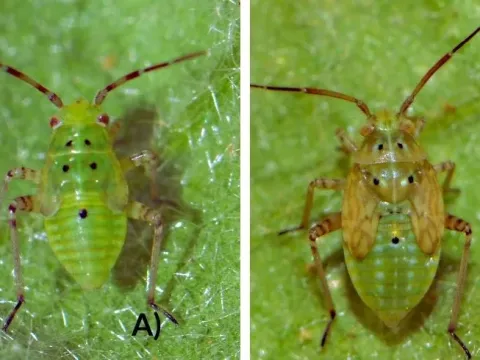
Meadow plant bug
Lygus pubescens
The meadow plant bug (Lygus pubescens) is a member of the Miridae family within the order Hemiptera. These insects are small, typically measuring between 5 and 7 millimeters in length, and are easily identified by the fine, dense hair covering their bodies.
What the section contains
Meadow plant bug
Their coloration ranges from yellowish-brown to dark brown, often featuring a distinct light-colored spot on the scutellum. Like other plant bugs, they possess a piercing-sucking mouthpart used for feeding on plant tissues.
Adult bugs overwinter in leaf litter, debris, and sheltered areas near field borders. As temperatures rise in spring, they become active and begin feeding on early vegetation.
Female bugs insert their eggs directly into the plant stems or leaf petioles. The lifecycle includes five nymphal stages before reaching adulthood, with nymphs resembling smaller, wingless versions of the parents.
Depending on the climatic conditions, multiple generations can occur throughout the growing season, contributing to rapid population growth in agricultural areas.
This species is highly polyphagous, meaning it feeds on a wide variety of plants. It is considered a significant pest for several important agricultural and horticultural crops.
Legumes such as alfalfa and clover, along with sugar beets and potatoes, are among the most frequently attacked. The bug feeds by extracting sap from tender buds, leaves, and developing flowers.
While feeding, the bug injects salivary enzymes that are toxic to plant cells. This process causes tissue necrosis, malformation of growth, and stunted development.
The loss of reproductive organs, such as flower buds and young fruit, directly correlates to reduced harvest yields. Plants may appear weakened and stunted in heavily infested fields.
The feeding punctures also serve as entry points for secondary pathogens, including various bacteria and fungi, which can lead to further plant decay.
Early symptoms of an infestation include the appearance of tiny, light-colored spots on the leaves. As the damage progresses, these spots turn brown and result in tissue death.
Plants affected by the bug often exhibit deformed foliage and curled leaf margins. The growth of the main stem may be inhibited, leading to a bushier, stunted appearance.
Flower buds often fail to bloom, turning brown and eventually dropping off the plant. This is particularly noticeable in crops like clover and certain vegetables.
Physical presence of the insects can be detected by inspecting the undersides of leaves and growing tips during the cooler hours of the day when the bugs are less flighty.
In fields, sweep netting is the standard diagnostic procedure to determine the density of the bug population and to assess the need for pest control interventions.
Effective management begins with sanitation. Controlling weeds in and around fields is crucial, as many weeds act as primary hosts for the bug before it migrates to cash crops.
Tilling and plowing after harvest helps destroy overwintering sites for adult bugs, significantly reducing the starting population for the following season.
Chemical control is required when population levels exceed economic thresholds. Systemic and contact insecticides are commonly used, with timing focused on the most vulnerable nymphal stages.
To support integrated pest management, choose insecticides that minimize impact on beneficial insects, such as natural predators and pollinators, by timing applications appropriately.
Biological control options, including the release of parasitic wasps that attack the eggs or nymphs, are increasingly being studied and used to suppress bug numbers in diverse ecosystems.