
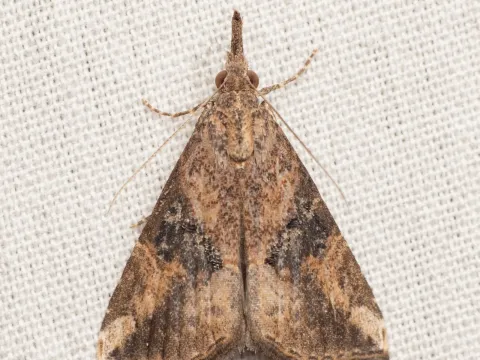
Green cloverworm
Plathypena
The Green cloverworm (scientific name: Plathypena scabra) is a moth species belonging to the Erebidae family. It is a well-known agricultural pest, particularly damaging to soybean fields and various forage legume crops in North America.
What the section contains
Green cloverworm
The adult moth has a wingspan of approximately 25 to 30 mm. Its forewings are typically dark brown or greyish with a jagged, irregular pattern, which provides excellent camouflage against dead foliage and soil debris during the day.
Larvae, or caterpillars, are pale green with thin, light-colored longitudinal stripes along their body. A key distinguishing feature is their locomotion; they move in a loping manner similar to loopers but have more abdominal prolegs, allowing for a distinct, swift movement.
The life cycle undergoes complete metamorphosis including the egg, larva, pupa, and adult stages. Depending on the geographical region, there may be multiple generations per year, with activity peaking during the mid-to-late summer months.
Overwintering occurs as either pupae or adults in protected environments, such as leaf litter, soil crevices, or under organic mulch. As temperatures rise in the spring, the overwintered adults emerge to begin the cycle of egg-laying on host plants.
The primary damage is caused by the larval stage, which feeds on the foliage of host plants. Soybean is the preferred host, and larvae consume significant amounts of leaf tissue as they progress through their developmental instars.
Early-stage larvae skeletonize the leaves, consuming the soft tissue and leaving the veins intact. Later stages consume the entire leaf blade, leading to irregular, ragged holes that significantly reduce the plant's photosynthetic capacity.
Damage is most detrimental during the reproductive stages of soybeans (R-stages), specifically flowering and pod formation. Severe defoliation during these times can lead to reduced seed weight, pod abortion, and lower overall yields.
The presence of larvae also creates entry points for secondary pathogens and diseases, further stressing the plant. In extreme cases of infestation, fields can look severely scorched due to the loss of green leaf area.
Understanding the impact of defoliation is essential for farmers, as soybeans can often tolerate moderate leaf loss during vegetative stages, but become highly sensitive once the plant transitions into the reproductive phase.
One of the earliest signs of a Green cloverworm infestation is the presence of small, irregular holes in the lower leaves of the crop. Careful inspection often reveals the presence of greenish or black frass (excrement) on the leaf surfaces.
Larvae are shy and reactive; if a plant is shaken or disturbed, they will often wiggle violently and drop to the ground on a silk thread or quickly crawl to the underside of a leaf to escape detection.
Visual signs also include the thinning of the canopy as the season progresses. Because the larvae prefer the inner and lower foliage initially, the damage may go unnoticed until the population increases and moves toward the upper leaves.
Moth activity can be monitored using light traps, which indicate the presence of adults in the area. High trap counts typically precede a flush of larval activity within the crop, providing a warning for scouting.
During daylight hours, scouting involves examining the leaves for larvae and signs of feeding. It is recommended to shake plants over a drop cloth to accurately assess larval density per unit area.
Cultural control practices include deep tillage after harvest, which disrupts the pupation sites and reduces the overwintering success of the moths. Managing weeds in and around the field can also reduce alternative hosts for the larvae.
Natural enemies, including predatory beetles, parasitic wasps, and various fungal pathogens, play a significant role in keeping populations below economic thresholds when managed correctly.
Biological insecticides, specifically those containing Bacillus thuringiensis (Bt), are highly effective against young larvae and are considered environmentally friendly, preserving beneficial insects in the field.
Chemical control should be used as a last resort, triggered only when economic threshold levels are reached. Always select labeled insecticides and apply them according to local regulations, considering the pre-harvest interval (PHI).
- Regular scouting is crucial during the R-stage of soybean development.
- Monitor the density of larvae per row foot before deciding on intervention.
- Rotate crops to break the life cycle of the pest where possible.