
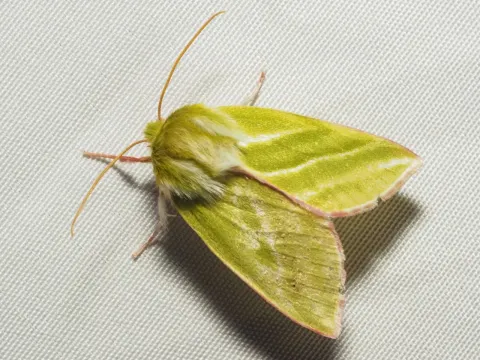
Green oak moth
Hylophila prasinana
The green oak moth (Hylophila prasinana) is a moth of the family Nolidae. With a wingspan ranging from 30 to 40 mm, it is a medium-sized insect often overlooked due to its excellent camouflage.
What the section contains
Green oak moth
The forewings are bright green with two or three distinct transverse white or yellowish lines. This coloration provides perfect blending against the green foliage of the host tree.
The larvae are bright green, spindle-shaped caterpillars reaching up to 35 mm in length. They are characterized by two longitudinal yellow dorsal lines and two prominent red conical projections at the rear.
The pupae are brown and smooth, encased in a tough, boat-shaped cocoon. These cocoons are typically constructed by webbing two leaves together, securing the larva until emergence.
This species is widely distributed across European woodlands and deciduous forests, where it thrives in environments dominated by oak species.
The primary host plant is the oak (Quercus), although in high populations, the caterpillars may also feed on beech, hornbeam, birch, and occasionally fruit trees.
Damage is caused exclusively by the larval stage. Young caterpillars skeletonize the leaves, while older larvae consume the entire leaf blade, leaving only the midribs and major veins.
Severe infestations lead to significant defoliation of the trees. This stress reduces the tree's ability to store energy, slowing growth and making it susceptible to secondary pests and diseases.
In forest nurseries and young plantations, the feeding activity can be devastating, leading to stunted growth or even the death of young seedlings if the attack persists for multiple years.
While mature trees can often recover from a single season of defoliation, successive years of heavy grazing significantly increase the risk of tree mortality and long-term decline.
The green oak moth completes one generation per year. It overwinters in the pupal stage, protected within its silken cocoon attached to twigs or hidden among leaf litter.
Adult moths emerge in late spring, typically from late May through June. They are nocturnal insects, remaining inactive and hidden under leaves during daylight hours.
Female moths deposit their eggs on the underside of host leaves. A single female can lay several hundred eggs, usually spacing them out individually across the canopy.
Larvae hatch in June and undergo rapid development through the summer months. They feed voraciously through July and August, reaching maturity before the onset of autumn.
By late August or early September, the fully grown caterpillars begin the process of pupation, creating the cocoon in which they will spend the winter months.
One of the earliest signs of an infestation is the presence of small, irregular holes in the foliage, followed by increasingly larger areas of leaf tissue being removed.
The most diagnostic feature is the presence of leaves webbed together with white silk. If you open these structures, you will often find the larvae resting or transitioning to the pupal stage.
Accumulation of larval frass (droppings) on lower branches or foliage is a strong indicator of an active caterpillar population feeding in the upper canopy.
In cases of heavy defoliation, the tree canopy will appear thin and ragged. The remaining leaves often show skeletonized patterns, and the trees may drop leaves prematurely.
Monitoring the adult population is possible through light traps, which effectively attract the moths during their flight period in early summer nights.
Promoting natural biodiversity is the first line of defense. Encouraging insectivorous birds, ants, and predatory insects helps keep larval populations below damaging thresholds.
Biological control using Bacillus thuringiensis (Bt) sprays is highly effective and recommended for high-value areas like parks or protected woodlands, as it specifically targets caterpillars.
Chemical intervention is generally reserved for severe outbreaks where there is a risk of significant loss of forest resources, using products with minimal impact on non-target species.
Silvicultural practices, such as removing dead wood and maintaining healthy stand density, help reduce the availability of suitable hibernation sites for the pupae.
Regular monitoring using pheromone traps allows land managers to detect the onset of adult activity, facilitating timely decisions on whether an intervention is necessary.