
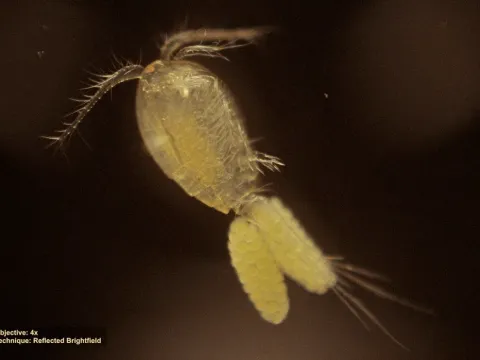
Green cyclops
Cyclops viridis
The green cyclops (Cyclops viridis) is a small freshwater crustacean belonging to the order Cyclopoida. These organisms are commonly found in natural water bodies and can occasionally become a nuisance in recirculating hydroponic and aquaponic systems.
What the section contains
Green cyclops
These creatures typically measure between 1 and 2 millimeters in length. They are characterized by a segmented body and a single light-sensitive eyespot, which gives them their distinctive look. Their antennae are used for quick, jerky swimming movements.
The life cycle of Cyclops viridis is characterized by rapid development. Females carry egg sacs on the sides of their abdomen, and in optimal conditions, the population can multiply exponentially within a short period of time.
These crustaceans are highly adaptable to environmental changes and are known to produce resting stages known as cysts. These cysts allow the species to survive drying, cold temperatures, and even some standard cleaning agents.
While they play a key role in natural aquatic ecosystems, their presence in artificial agricultural setups is generally discouraged due to their competitive nature and potential for population explosions.
In hydroponic systems, particularly those using deep water culture (DWC), green cyclops can cause damage by feeding on young root hairs. While not primary herbivores, they can stress the plant roots, especially during the early seedling stages.
The mechanical damage caused by a massive population of cyclops creates entry points for various secondary pathogens, including root rot agents like Pythium and other deleterious bacteria.
In aquaponics, these crustaceans compete with fish fry for feed resources. They consume phytoplankton and micro-organic particles, potentially depriving fish stock of essential food sources and leading to lower growth rates.
Accumulation of their metabolic waste products significantly disrupts the chemical balance of the nutrient solution. This often leads to fluctuations in pH and electrical conductivity (EC), making it difficult to maintain stable nutrient levels.
Large populations also cause water turbidity, which hides roots from visual inspection and may lead to clogged irrigation lines or malfunctioning pumps over extended periods of time.
The green cyclops thrives in warm conditions, with an optimal temperature range of +18°C to +25°C. In controlled greenhouse environments, these conditions are often constant throughout the year.
The initial introduction of the pest usually occurs through water supplies drawn from open reservoirs or wells that have not been adequately filtered or sterilized, especially during spring and summer bloom periods.
While their activity slows down in cooler temperatures, they do not disappear entirely. They are capable of remaining dormant as cysts until conditions improve, meaning an infestation can reappear quickly after a system is restarted.
Population peaks are typically observed during long cycles without system maintenance. As biofilms build up on tank walls, they provide both food and shelter for the growing cyclops population.
Early detection is crucial. Monitoring water samples at the beginning of each season helps prevent the pest from becoming firmly established within the irrigation plumbing and reservoirs.
The most obvious sign of an infestation is the presence of small, fast-moving particles in the nutrient solution. Holding a glass of water up to a light source will reveal their characteristic jerky swimming patterns.
Root systems may appear discolored, turning brown or greyish. In severe cases, a layer of mucus or slime—composed of waste products and crustacean remains—can be observed clinging to the root tips.
Unexplained shifts in nutrient solution pH are a frequent warning sign. Since cyclops consume nutrients and excrete waste, they can override the buffering capacity of the solution, causing unstable chemical readings.
If the system is connected to a fish tank, aquaponic managers may notice the fish acting lethargic or exhibiting poor feeding responses, as the cyclops consume a significant portion of the available food base.
Clogged filters or sensors covered in debris are another sign. The waste from a large population of cyclops can build up quickly, forcing filtration systems to work much harder than usual.
The most effective strategy for managing green cyclops is rigorous mechanical filtration. Installing fine mesh filters (50 microns or smaller) on all water intake and recirculation lines effectively removes adults from the system.
Ultraviolet (UV) sterilization is considered the gold standard in professional setups. A properly sized UV unit installed in the circulation loop will eliminate cyclops and their larvae, preventing population growth without affecting plant health.
Regular maintenance is essential. Deep cleaning of tanks, reservoirs, and piping helps remove the biofilm that serves as a breeding ground for these crustaceans. Chemical cleaning agents like hydrogen peroxide can be used to treat empty systems.
Avoid using untreated water sources. If well or surface water is necessary, ensure it undergoes a multi-stage treatment process including sedimentation, filtration, and UV or ozone sterilization.
- Utilize fine-mesh filtration (50 microns).
- Install high-output UV-C sterilizers in the water loop.
- Perform regular system flushes and cleanings.