
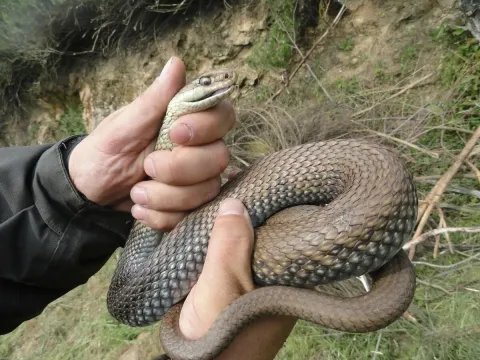
Montpellier snake
Malpolon monspessulanus
The Montpellier snake (Malpolon monspessulanus) is a species of colubrid snake belonging to the family Lamprophiidae, widely distributed in Mediterranean regions.
What the section contains
Montpellier snake
It is characterized by a large size, with adults often exceeding 1.5 to 2 meters in length, and a head with prominent, overhanging supraocular scales.
The dorsal scales have a slight longitudinal groove, providing the snake with a distinct appearance compared to other regional ophidians.
As an opisthoglyphous snake, it possesses rear-fanged venomous apparatus, which is primarily used to immobilize small prey rather than defend against large threats.
The coloration typically shifts from a mottled pattern in juveniles to a uniform olive or brownish color in adults, aiding in camouflage within dry vegetation.
While not a direct herbivore, the Montpellier snake negatively influences agricultural biodiversity by disrupting the predator-prey balance in fields.
By preying on lizards and small mammals, the snake reduces the population of natural insect controllers, leading to potential spikes in harmful pest activity.
The presence of large snakes in vineyards or orchards can impede manual labor, as workers may avoid areas where snakes are known to congregate.
High population densities of the species can lead to damage to drip irrigation lines or young tree supports, which the snakes use as structural anchors.
The indirect harm to agricultural output occurs when the ecosystem's self-regulating mechanism (predatory lizards/mammals) is suppressed by the snake's presence.
The activity cycle of the Montpellier snake is highly seasonal, beginning in spring when ambient temperatures allow for thermal regulation.
Peak activity is observed from late spring through mid-summer, corresponding with the breeding season and high metabolic demands for hunting.
During the intense heat of summer, the snakes become less visible, shifting their activity to early morning or late evening hours to avoid overheating.
Autumn brings a reduction in foraging intensity as the reptiles prepare to retreat into burrows or crevices for the upcoming winter dormancy.
Winter dormancy occurs underground, where the snakes survive in deep cavities until spring temperatures induce emergence.
Effective management focuses on habitat modification, such as regular mowing of field borders and the removal of piles of debris or stones.
Removing potential shelter sites makes the area less attractive to snakes, encouraging them to migrate to more suitable, less managed wild areas.
Biological control includes promoting local bird of prey populations, which naturally keep snake numbers in check within the agroecosystem.
If snake density is high, professional relocation services should be engaged rather than attempting direct handling, due to the snake's potential for defensive biting.
- Maintain short vegetation along access roads.
- Remove rock piles and construction waste from crop fields.
- Use physical barriers where sensitive crops require protection from general fauna.