
Moon caddisfly
Limnephilus lunatus
Description
How to identify
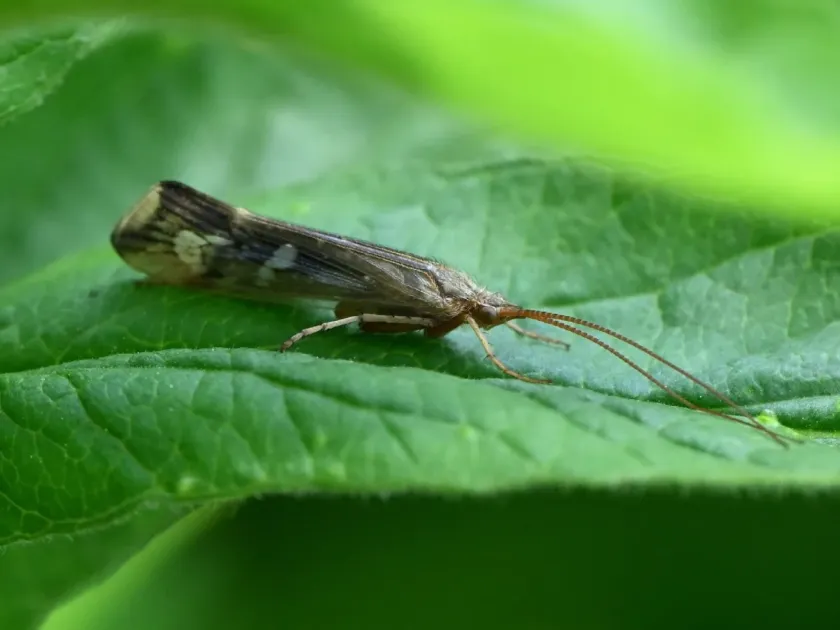
The moon caddisfly (Limnephilus lunatus) is an insect belonging to the order Trichoptera and the family Limnephilidae. Adult individuals are moth-like insects with a wingspan of up to 30 mm, displaying distinct crescent-shaped markings on their forewings.
The larval stage is uniquely identified by the protective case they construct. This case is crafted from various materials found in their habitat, such as sand, gravel, and plant fragments, which serve as camouflage and physical protection.
The larva features a highly sclerotized head capsule, which provides the necessary strength to feed on tough aquatic plant tissues. Their coloration varies from grey to brown, allowing them to blend seamlessly with the bottom of aquatic environments.
Their life cycle includes complete metamorphosis. Eggs are typically laid in gelatinous masses on aquatic vegetation or directly into the water, ensuring that the offspring have immediate access to food upon hatching.
Adults are primarily nocturnal and demonstrate positive phototaxis. This behavior makes them easily detectable by light traps, which are often used in agricultural monitoring programs to track population dynamics.
What it damages
The primary damage is caused by the larval stage, which feeds voraciously on the tissues of aquatic and semi-aquatic plants. Crops grown in flooded conditions, such as rice or water-based vegetables, are particularly susceptible.
Larvae scrape the epidermis of leaves or consume the entire leaf lamina, leaving behind irregular holes and skeletal remnants. In cases of high population density, this feeding activity can drastically reduce the photosynthetic capacity of the plants.
Furthermore, larvae often cut into stems to harvest materials for their protective cases. This physical damage can lead to the collapse or death of young shoots, causing significant yield losses in commercial crops.
The wounded tissues provide entry points for secondary infections, including fungal and bacterial pathogens. These infections can quickly spread throughout a field, exacerbating the damage caused by the insect feeding itself.
The severity of the damage is correlated with the population size and the stage of crop development. Young plants are most vulnerable to complete destruction during the period of intensive vegetative growth.
When it appears
Adult activity peaks during the summer months, typically ranging from June to September. This is the period of mass emergence, during which mating and egg-laying occur within the aquatic environment.
Larval activity is highest during the spring and summer when water temperatures favor rapid development. Consequently, this is when the threat to agricultural crops is at its maximum.
In temperate climates, the species overwinters as a larva or egg, remaining in a state of diapause at the bottom of water bodies. This allows the population to survive harsh winter conditions successfully.
Spring warming triggers the reactivation of larvae, and their feeding activity often synchronizes with the initial growth phases of agricultural crops, creating a significant challenge for early-season management.
The number of generations per year is dependent on the geographical location. In warmer climates, it is possible for the species to complete multiple generations within a single agricultural season.
Signs of infestation
The most reliable sign of a moon caddisfly infestation is the presence of portable larval cases attached to plant stems or moving along the substrate. These are easily spotted upon close inspection.
Ragged leaf edges and missing tissue patches on submerged or emergent parts of the crop are clear indicators of larval feeding. If these symptoms are widespread, it suggests a potential population outbreak.
The observation of adult caddisflies near artificial light sources at night confirms the presence of the pest and indicates the beginning of a new reproductive cycle.
Premature wilting or yellowing of specific stems, where there is no evidence of root rot, often points to structural damage caused by larvae harvesting material for their cases.
The presence of gelatinous egg masses on aquatic plants or at the water's edge is another diagnostic sign, indicating future infestation sites and the need for immediate monitoring.
Control measures
Effective management begins with cultural control, such as regular maintenance of irrigation channels and the removal of excessive aquatic vegetation that serves as a habitat for larvae.
In managed systems, temporary drainage of fields can be a highly effective control measure, as it exposes the larvae and eggs to air, causing rapid desiccation and mortality.
Light traps are a valuable tool for monitoring adult populations. Using these traps strategically can also help reduce the number of adults, thereby limiting the number of eggs laid in the crop area.
Chemical control should be approached with caution due to the potential impact on aquatic ecosystems. Selective insecticides that have minimal residual effects on the water supply are preferred.
Biological control, including the use of native predators or specific entomopathogenic fungi, is an area of ongoing research that offers sustainable long-term solutions for managing moon caddisfly populations.
Discussion
No discussions yet — be the first.