
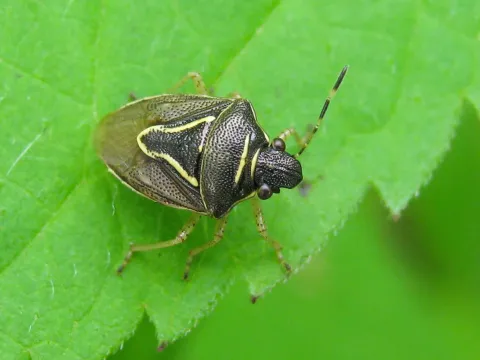
Mormidea poecila
Mormidea poecila
Mormidea poecila is a species of insect belonging to the order Hemiptera and the family Pentatomidae, commonly known as stink bugs. It features a flattened, shield-like body shape which is typical for this family, allowing it to hide effectively within plant structures.
What the section contains
Mormidea poecila
The adult is typically brownish or yellowish-brown with a mottled pattern of dark and light spots, providing excellent camouflage on green vegetation. The margins of the head and the pronotum are slightly serrated, which is a key diagnostic feature for this specific genus.
The lifecycle includes the egg stage, five nymphal instars, and the adult stage. Eggs are usually deposited in clusters on the underside of host plant leaves, often arranged in neat rows, which serves as a vital indicator during field scouting.
Nymphs of early instars differ in appearance from adults and undergo several molts before reaching maturity. Throughout their life cycle, these bugs remain secretive, preferring areas with dense foliage that provides high humidity and protection from predators.
Mormidea poecila is a thermophilic species, meaning its activity is strongly linked to temperature. Warm periods with moderate rainfall are ideal for rapid population growth and the successful development of all nymphal stages.
This bug is a polyphagous pest that attacks a wide variety of agricultural crops. It inflicts significant damage on cereals, legumes, and several vegetable species, making it a major concern in various agricultural regions.
The pest feeds by piercing plant tissues with its proboscis to suck sap from stems, leaves, or young fruit. While feeding, it injects saliva containing enzymes that cause physiological disturbances and local tissue necrosis in the plant.
Economic damage is most severe when the bug feeds on reproductive organs such as grains and bean pods. This leads to stunted grain development, reduced crop yields, and compromised quality of seed material intended for future planting.
In addition to direct mechanical injury, feeding sites serve as entry points for pathogens, including various fungi and bacteria. This can lead to secondary infections that cause the premature wilting or rotting of plant parts.
Under high population pressure, severe plant deformation and growth stunting are common. In years favorable to the pest, yield losses can be substantial if proper management strategies are not implemented in time.
The first sign of an infestation is the appearance of small, pale spots on leaves, which may eventually coalesce and cause the entire leaf to yellow. Careful observation of the lower plant sections usually reveals the presence of the insects.
Damage to cereal heads often manifests as white-heading or shriveled grains that are abnormally light. These affected plants typically stand out from the surrounding healthy crop due to their altered structure and coloration.
The presence of feces in the form of small dark dots on leaves is a clear indicator of a resident population. Additionally, egg clusters found on the underside of leaves are definitive evidence of active breeding within the field.
Insects are easiest to observe during the early morning or evening hours when they move to upper plant parts to feed. When disturbed, the bugs often drop to the ground, making them difficult to spot among crop residues.
A distinct, unpleasant odor is often released by the bugs when they are disturbed or when their density is high, which serves as a sensory indicator of their presence for experienced agronomists.
Effective management begins with strict adherence to agricultural practices designed to reduce pest reservoirs. Clearing weeds from field margins is essential, as these plants often serve as early-season hosts for Mormidea poecila.
Insecticide application should be based on economic threshold levels. Contact and systemic insecticides registered for use against stink bugs on specific crops should be applied to minimize population levels before significant damage occurs.
Biological control methods involve supporting natural enemies, such as egg parasitoids like Telenomus species. Maintaining ecological corridors and avoiding broad-spectrum pesticides can help preserve these beneficial populations.
Timely harvesting is a critical practice to limit the time the pest has to feed on the crop. Post-harvest cultivation, such as disking, helps destroy crop residues and soil-level shelters where the bugs may overwinter.
- Implementation of crop rotation to break the pest cycle.
- Regular field monitoring using sweep nets to estimate population density.
- Selection of crop varieties with higher resilience to early-season piercing damage.