
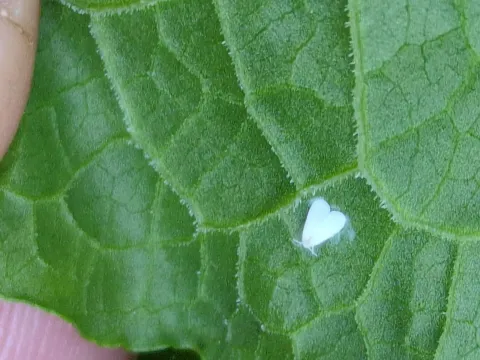
Mossop's whitefly
Trialeurodes mossopi
Mossop's whitefly (Trialeurodes mossopi) is a small insect belonging to the family Aleyrodidae, within the order Hemiptera. Adult individuals are characterized by a white waxy coating on their wings, providing protection against moisture.
What the section contains
Mossop's whitefly
Identification of this species is challenging due to the morphological similarity with other Trialeurodes members. Specialists typically analyze the puparium stage (the final larval instar) to verify the species based on specific bristles.
The biology of the species is closely tied to greenhouse conditions and regions with mild climates. Reproduction is sexual, with females laying dozens of eggs on the underside of leaves, anchoring them with small stalks.
The life cycle encompasses the egg stage, four larval instars, and a puparium stage. Development is highly temperature-dependent, significantly accelerating under greenhouse conditions exceeding 25 degrees Celsius.
The insect typically lives in sheltered environments, congregating in the lower, shaded canopy of plants, making early detection during routine inspections difficult.
This pest attacks a wide range of crops, including solanaceous plants, cucurbits, and various ornamental species. Colonies are most frequently observed in greenhouse-grown vegetables.
Primary damage is caused by nymphs (larvae) that feed on plant sap by piercing the leaf epidermis. This process depletes the plant's resources and stunts overall development.
During feeding, whiteflies excrete a sugary substance known as "honeydew," which serves as a substrate for sooty mold fungi. The resulting black coating impairs photosynthesis, severely reducing yield and quality.
Beyond mechanical injury, the species serves as a potential vector for several plant-pathogenic viruses. Viral infections can lead to total crop failure or complete loss of market value for the produce.
Mass infestations often result in leaf deformation, yellowing (chlorosis), and premature abscission, which is especially detrimental to seedlings and young, vulnerable plants.
In greenhouses, Mossop's whitefly can maintain continuous year-round reproduction if a host supply and suitable temperature conditions are present, allowing overlapping generations.
In outdoor environments, the pest's activity is concentrated during the summer months when daily average temperatures remain high. Rainfall and sudden cold spells may provide temporary population suppression.
Peak population density usually occurs in the late summer, as cumulative generations reach critical levels. This period represents the highest risk of migration to neighboring fields.
As temperatures decline in the autumn, adult activity decreases; however, eggs and puparia can remain viable in plant debris, ensuring the survival of the species until the following season.
Monitoring should commence with the first warm days of spring, utilizing yellow sticky traps to detect the arrival of migrating adults early in the season.
The most prominent sign of infestation is the presence of a "cloud" of small white insects that take flight upon the slightest disturbance of the plant foliage.
On the undersides of leaves, one may find transparent or yellowish scales, representing the larvae and puparia. The presence of eggs is a clear indicator of active reproduction.
Leaf surfaces often become sticky to the touch due to the excreted honeydew. Subsequently, a black soot-like layer appears, caused by the colonization of sooty mold fungi.
Infested plants exhibit signs of stress, such as leaf curling and loss of turgor, even when irrigation is sufficient. Growth of apical shoots and flower buds is significantly inhibited.
- Yellowing of leaf margins.
- Presence of sticky honeydew residue.
- Development of sooty mold on leaf surfaces.
- Curling and deformation of young leaves.
- Visible white insects upon shaking the plant.
Effective management of Mossop's whitefly requires an integrated pest management (IPM) approach, incorporating cultural, biological, and chemical control methods.
Cultural practices include the strict removal of host weeds that serve as reservoirs and deep plowing of soil after the harvest to eliminate potential overwintering sites.
Biological control involves the strategic use of natural enemies, such as the parasitic wasp Encarsia formosa, which successfully targets the whitefly puparia in greenhouse settings.
Chemical control necessitates the rotation of insecticides with different modes of action to prevent the development of resistance. Systemic insecticides are generally the most effective.
All chemical applications must strictly adhere to environmental regulations and the mandatory pre-harvest intervals specified on product labels to ensure food safety and ecosystem protection.