
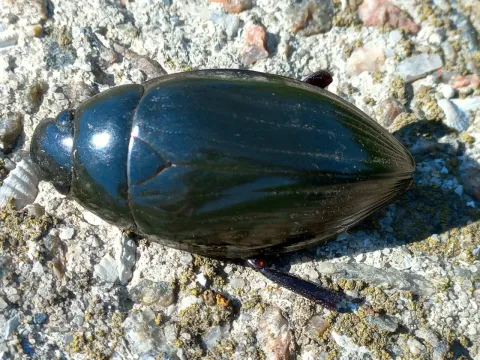
Great silver water beetle
Hydrous piceus
The great silver water beetle (Hydrophilus piceus, formerly Hydrous piceus) is a large aquatic insect in the family Hydrophilidae, order Coleoptera.
What the section contains
Great silver water beetle
Adult beetles can reach up to 50 mm in length, possessing an oval-shaped, convex body with a deep black color and a distinct olive-green sheen.
The larvae are carnivorous and look like large, greyish-brown grubs with a well-developed mouthpart structure for feeding.
These insects are adept swimmers and spend most of their life in stagnant or slow-moving water bodies, surfacing periodically to breathe using their antennae.
In agricultural environments, they inhabit irrigation canals and flooded paddy fields where they can negatively impact plant health.
The pest primarily threatens rice crops, specifically targeting seedlings immediately after the fields are flooded.
Larvae feed aggressively on the young shoots and roots of rice plants, which frequently results in total plant destruction and field thinning.
Adult beetles, though largely herbivorous or scavenging, may also damage the epidermis of vegetative parts of young crops during peak population growth.
The resulting damage reduces the density of the crop stand, leading to significant economic losses for rice producers.
Heavy damage is often concentrated in areas with thick aquatic vegetation that provides cover and food for the beetle larvae.
The life cycle begins in spring when water temperatures rise sufficiently to trigger mating and egg-laying activities.
Females produce cocoons, which are attached to submerged plants to protect the developing eggs from predators.
The larval stage lasts for several weeks, during which the larvae grow rapidly and cause the most significant crop damage.
Pupation takes place in the soil near the banks of the water bodies, after which the adults emerge and disperse.
Adults overwinter in the mud or soil at the bottom of ponds and channels to survive the winter temperatures.
Deep autumn plowing is recommended to destroy overwintering sites and reduce the beetle population for the following season.
Regular maintenance and cleaning of irrigation canals help to minimize the favorable environments for the beetle's development.
Short-term drainage of paddy fields is a highly effective cultural practice to kill larvae by exposing them to drying conditions.
When infestation thresholds are exceeded, targeted application of approved insecticides may be necessary to protect the rice crop.
Integrated pest management strategies should emphasize the role of natural predators in keeping beetle populations under control.