
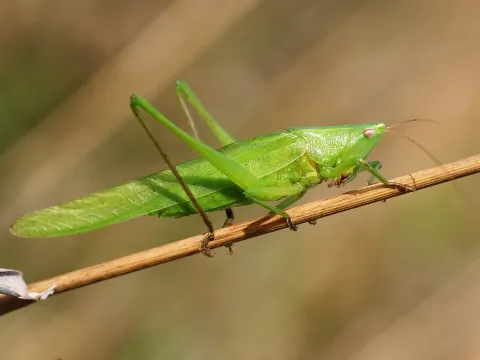
Great green bush-cricket
Homorocoryphus nitidulus
The Great green bush-cricket (scientific name Ruspolia nitidula, often referred to as Homorocoryphus nitidulus) is a prominent member of the Tettigoniidae family.
What the section contains
Great green bush-cricket
Adults are easily identifiable by their elongated, slender bodies, which typically range from 25 to 35 mm in length, and their signature cone-shaped head projection.
Their coloration is generally a blend of green or brownish-yellow, providing highly effective camouflage within grasses and cereal crops.
These insects are strong flyers, possessing well-developed wings that allow them to migrate effectively between wild habitats and agricultural fields.
The life cycle involves incomplete metamorphosis, where nymphs resemble smaller, wingless versions of the adults, gradually maturing through several growth stages.
This species is considered a generalist herbivore but is known to cause significant economic damage to cereal crops, including rice, wheat, and corn.
The primary damage occurs during the milk and dough stages of grain development, where the insects chew and consume the developing kernels.
Beyond the grain itself, the bush-crickets feed on leaves and young stems, which can lead to reduced plant vigor and increased susceptibility to fungal diseases.
In high-density outbreaks, they can defoliate significant portions of a crop, particularly near the edges of fields bordering unmanaged meadow areas.
The damage is often overlooked until substantial grain loss is visible, as the insects prefer to feed during the twilight and nighttime hours.
The life cycle is strictly seasonal, with overwintering occurring in the egg stage, which is usually buried in soil or inserted into plant tissues.
Nymphs emerge during the spring once soil temperatures reach a threshold, beginning their development by feeding on young grasses and vegetation.
The adult stage typically peaks in late summer and early autumn, which is a critical time for grain maturation and harvesting activities.
Temperatures and humidity play a crucial role in the survival rate of the population, with warm, damp summers often leading to larger adult populations.
The generation time is strictly annual, meaning the population pressure is highly dependent on the success of the overwintering generation.
One of the most obvious signs of infestation is the irregular, ragged edge damage to leaves, often leaving the main veins intact.
Grain heads exhibit missing or partially eaten kernels, leaving gaps in the ears of wheat, barley, or rice crops during the final stages of ripening.
A loud, continuous stridulation or "chirping" sound heard at night is a primary auditory indicator of a high population density within the crop canopy.
Physical sightings of the insects, especially near the perimeter of the field, serve as a strong warning to monitor the crop more closely.
The presence of insect frass (droppings) on the leaf surfaces or the ground beneath the plants provides further confirmation of their localized activity.
Effective management begins with landscape sanitation, specifically cutting back tall grass and weeds on field borders that serve as breeding grounds.
Deep plowing in the autumn can disturb and destroy overwintering egg sites in the soil, significantly reducing the potential population for the next season.
If population numbers exceed economic thresholds, targeted insecticide applications during the early nymph stages can prevent severe late-season damage.
Encouraging natural predators such as birds and ground beetles can provide a level of biological control in integrated pest management systems.
- Regular night monitoring with light traps to detect spikes in activity.
- Application of biological pesticides containing entomopathogenic fungi.
- Harvesting crops promptly to remove the food source before the peak population arrives.