
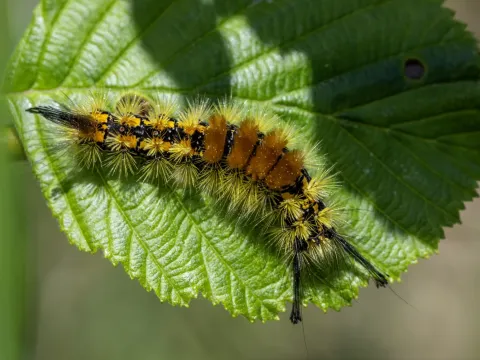
Western tussock moth
Hemerocampa vetusta
The Western tussock moth (Hemerocampa vetusta) belongs to the family Erebidae. It is characterized by significant sexual dimorphism where adult females are flightless due to vestigial wings, while males are fully winged and capable of active flight.
What the section contains
Western tussock moth
Larvae are easily identifiable by the dense tufts of hair on their bodies, which often serve as a warning coloration. These hairs can cause skin irritation in humans and are an evolutionary defense against predators.
The life cycle involves complete metamorphosis, including egg, larva, pupa, and adult stages. Only one generation typically occurs per year, depending on the climatic conditions of the region.
Eggs are laid in clusters, usually on top of the old cocoon from which the female emerged. These clusters are protected by a felt-like or frothy substance that aids in winter survival.
The species is primarily associated with native woody plants but easily adapts to cultivated orchard trees, making it a subject of agricultural interest.
As a polyphagous pest, the Western tussock moth feeds on a wide range of plants, including various fruit trees such as apple, pear, and plum, as well as several ornamental and forest trees.
Caterpillars cause extensive defoliation by feeding on leaf tissue. In severe cases, they skeletonize the leaves, leaving only the veins, which drastically reduces the tree's photosynthetic capability.
Early-season feeding on buds and emerging shoots can lead to stunted growth and poor fruit development. This cumulative stress weakens the plant over several growing seasons.
Trees that suffer from heavy defoliation become more susceptible to secondary pest attacks and various opportunistic fungal diseases that exploit the weakened tissue.
Orchards located near native vegetation are particularly prone to infestation, as the moths can readily migrate from natural hosts to agricultural crops.
The species overwinters in the egg stage. The eggs remain dormant in protected clusters attached to twigs or bark until the return of warmer weather in the spring.
Larval emergence is synchronized with the bud-burst period of host trees. The caterpillars feed aggressively during the late spring and early summer months as they grow.
Pupation occurs in mid-summer. Larvae construct cocoons using silk and mixed debris, which are usually attached to leaves or branches, providing a safe environment for transformation.
Adult moths emerge, mate, and deposit eggs in late summer or early autumn. These eggs will then remain on the host plant throughout the winter until the cycle restarts.
The survival rate of overwintering eggs is heavily influenced by winter temperatures; harsh winters can lead to a significant decline in the population the following spring.
The most visible sign of infestation is the presence of eaten leaves with irregular or ragged edges. Damage to opening buds, leading to missing or malformed foliage, is also common.
Silk cocoons found attached to foliage or bark are clear indicators of the pest's life cycle progression within the area. These are often easy to spot during regular inspections.
The presence of hairy caterpillars crawling on trunks and branches during the active feeding season confirms an infestation. In dense populations, the sound of active feeding can often be heard.
Frass (caterpillar droppings) accumulating on the ground or on lower leaves is a reliable, indirect sign of heavy infestation in the tree canopy above.
During the dormant season, inspect the bark for the characteristic light-colored, felted egg masses, which are the primary target for manual control efforts.
Mechanical removal is highly effective for localized infestations. Scraping off and destroying egg masses during the winter months is a critical step in reducing next year's population.
Biological control using formulations of Bacillus thuringiensis is an environmentally friendly option that effectively targets young caterpillars without harming beneficial pollinators or predators.
Chemical intervention should be reserved for threshold-exceeding infestations and applied during the early larval stages when the caterpillars are most vulnerable to insecticides.
Promoting a healthy environment for natural enemies, such as parasitic wasps and predatory beetles, can provide long-term suppression of moth populations.
- Monitor adult flight activity using pheromone traps to time management actions.
- Use sticky bands or barriers on tree trunks to prevent larvae from moving between trees.
- Prune and destroy heavily infested branches during the dormant period.