
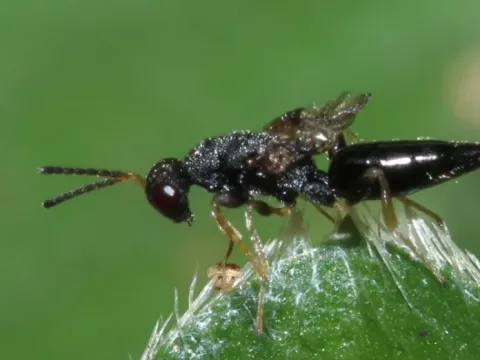
Wheat jointworm
Harmolita
The Wheat jointworm (Harmolita) is a species belonging to the Eurytomidae family within the Hymenoptera order. These are small, wasp-like insects typically measuring 2 to 5 mm in length.
What the section contains
Wheat jointworm
Adults are generally black, sometimes exhibiting a metallic sheen. Females possess a specialized ovipositor designed to penetrate plant stems to deposit eggs.
Larvae are legless, white to yellowish in color, and feature a robust head capsule. They live exclusively inside the stems of cereal crops, remaining hidden from typical field observations.
The development cycle includes complete metamorphosis. The larvae overwinter inside crop stubble or other plant debris, which is critical to their survival.
Adult emergence typically aligns with the stem elongation phase of cereal crops, which is the period when the plant is most vulnerable to infestation.
The primary hosts for the Wheat jointworm include wheat, rye, and barley. Larvae cause damage by feeding on the internal tissues of the stem, disrupting nutrient flow.
By damaging the vascular system of the stem, the larvae hinder the development of the grain head, leading to shriveled kernels and significant weight loss.
Infestations are particularly damaging during dry seasons, as the compromised plants struggle to maintain necessary water transport and overall growth.
Crop losses can range between 20% and 30% in highly infested fields, significantly impacting the economic return of the cereal production.
Furthermore, damaged stems become fragile and prone to lodging, which complicates harvesting operations and further exacerbates yield losses.
Adults emerge in the spring, usually in May or June, coinciding with the jointing stage of cereal crops. This marks the onset of the infestation cycle.
After mating, females lay eggs inside the stems. The hatching larvae immediately begin feeding within the internodes throughout the summer months.
The larvae develop inside the plant during the growing season and remain in a state of diapause inside the stubble throughout the winter period.
The species completes one generation per year, making it a persistent threat in areas where cereal production is centralized.
Pupation occurs in early spring, following which the adults chew their way out of the stubble to start the cycle again as soon as the weather warms.
The most reliable sign of an infestation is the presence of small, circular exit holes on the stems where adult insects have emerged.
Infected fields often show uneven growth, with individual stems prematurely yellowing and wilting despite otherwise healthy surrounding plants.
Heads on damaged plants are often stunted and carry much lighter grain compared to healthy ones, reflecting the internal damage caused during development.
Careful examination of the stem by cutting it longitudinally will reveal larvae or evidence of feeding galleries, which confirms the presence of the pest.
Field-wide yield reduction and the presence of low-density grain at harvest are strong indicators that the Wheat jointworm has been active in the crop.
Effective management requires a combination of cultural practices aimed at disrupting the lifecycle and reducing overwintering populations.
- Deep plowing and soil inversion after harvest to bury stubble and prevent adult emergence.
- Implementation of crop rotation cycles to ensure non-host crops are grown in infested fields the following year.
- Removal and destruction of wild grasses that serve as alternative hosts for the pest.
- Using resistant cereal varieties that have thicker or more lignified stems, making them harder for larvae to penetrate.
- Maintaining soil fertility to ensure strong plant development, which helps crops withstand minor larval damage.