
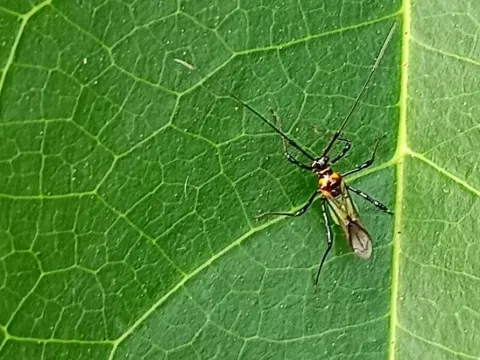
Cocoa mosquito bug
Helopeltis theobromae
The cocoa mosquito bug (Helopeltis theobromae) belongs to the order Hemiptera and the family Miridae. It is easily recognized by its long legs and antennae, and a distinct, backward-curved spine on its thorax (scutellum).
What the section contains
Cocoa mosquito bug
Adults typically measure between 7 to 10 mm in length. Their coloration ranges from reddish-brown to almost black, which provides excellent camouflage against the foliage and young fruit of host trees.
Females insert their eggs into plant tissues, specifically preferring petioles and young shoots, providing a safe environment for the embryos to develop.
The nymphs resemble smaller, wingless versions of the adults. They undergo five distinct developmental stages (instars) before reaching maturity.
In tropical climates, the entire lifecycle is completed in approximately one month, allowing for several generations throughout the year and rapid population growth.
While primarily a pest of cocoa, Helopeltis theobromae also attacks tea, cotton, cashew, and several other tropical crops, causing significant economic damage.
The pest feeds by piercing and sucking sap from young, tender parts of the plant, including shoots, fruit pods, and developing leaves, using its needle-like mouthparts.
During feeding, the bug injects saliva containing enzymes that cause necrosis of the cells, leading to physical deformation and growth stunting in the affected plant organs.
The most severe damage occurs on young cocoa pods, which can become necrotic or deformed, rendering them unfit for harvest and reducing the overall quality of the yield.
High infestations of this bug can result in 60-80% yield losses if left uncontrolled, making it a major challenge for cocoa farmers globally.
The first sign of infestation is the appearance of small black spots at the feeding sites, which rapidly expand into necrotic lesions due to the plant's reaction to the bug's salivary toxins.
Young shoots often curl and eventually die back, while leaves may show numerous holes, turn yellow, and fall prematurely, leading to general tree weakening.
Cocoa pods develop deep brown or black lesions or ulcers. These cracks often serve as entry points for secondary fungal and bacterial pathogens, leading to fruit rot.
An overall reduction in tree vigor and stunted growth can be observed in orchards with a sustained presence of the bug.
- Necrotic spots on young pods.
- Dieback of terminal shoots.
- Deformed leaves and fruit.
- Increased secondary infections on pods.
Integrated Pest Management (IPM) is essential for controlling the cocoa mosquito bug, utilizing a combination of cultural practices, biological agents, and selective chemical treatments.
Cultural control involves regular pruning of infected twigs and removal of damaged pods to reduce the pest population density within the orchard.
Maintaining optimal spacing and tree density is crucial to ensure good airflow and reduce the humidity levels that favor the rapid reproduction of the bug.
Biological control methods emphasize the use of predatory ants, which actively hunt nymphs, as well as the application of entomopathogenic fungi to suppress populations.
Chemical control is applied only when economic thresholds are reached, utilizing insecticides that are specific to the pest while protecting beneficial insect populations.