
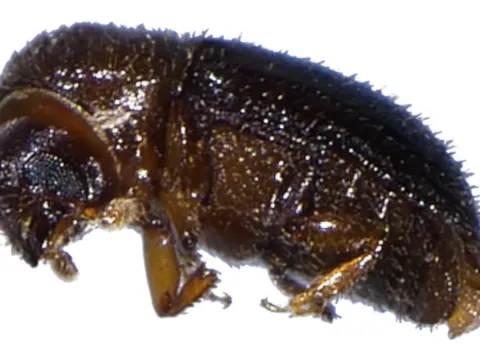
Coffee berry borer
Stephanoderes polyphagus
The coffee berry borer, scientifically identified as Stephanoderes polyphagus, is a member of the Curculionidae family and the Scolytinae subfamily. These insects are extremely small, typically measuring between 1.5 to 2 mm in length.
What the section contains
Coffee berry borer
The adult beetle possesses a cylindrical, dark brown or nearly black body. The surface of the elytra is covered in fine, dense setae, which gives the insect a somewhat textured appearance when viewed under magnification.
Larvae are legless and possess a white, fleshy body with a distinct brown head capsule. Their development occurs exclusively inside the plant tissue, making them difficult to detect during the early stages of infestation.
Sexual dimorphism is present: males are significantly smaller and often lack functional wings, meaning they do not participate in flight. Females are responsible for the dispersal of the species and for selecting suitable fruits for egg-laying.
The life cycle is tightly integrated with the host plant, where the beetle completes its transition from egg to adult within the fruit or seed. This protected environment ensures high survival rates under favorable climatic conditions.
Although named after its affinity for coffee, this beetle is a polyphagous pest capable of infesting various stored grain products and tropical crops. It poses a significant threat to global agricultural trade and seed storage.
Both adults and larvae contribute to damage by boring tunnels into the seeds. This destroys the structural integrity of the seed, leading to substantial weight loss and a decrease in the quality of the harvested product.
In infested crops, the presence of the beetle compromises the commercial value, as the damage provides entry points for secondary pathogens like fungi and bacteria, which can cause rotting and mycotoxin contamination.
When infestation occurs in stored grain, the cumulative feeding activity of the larvae can reduce a bulk storage lot to nothing more than dust and fecal material, rendering it entirely unfit for human or animal consumption.
- Direct damage to coffee beans and similar tropical fruits.
- Destruction of seed embryos, leading to loss of germination capacity.
- Economic losses due to lower grading of contaminated produce.
- Secondary infection by mold and pathogens within tunnels.
The most reliable sign of an infestation is the presence of small, perfectly round entrance holes on the surface of the beans or fruits. These are often accompanied by a fine, dusty frass surrounding the opening.
A musty or decaying odor emanating from stored grain bags often indicates an advanced infestation. This smell is typically caused by the breakdown of seed tissue and the subsequent growth of fungal colonies inside the grain.
Internally, infested seeds exhibit extensive boring patterns that often look like a branching network of tunnels. Within these tunnels, one can identify various stages of the pest, including larvae and pupae.
Visually, fruits may appear shriveled or exhibit darkened spots. If a seed feels hollow or crumbles easily upon being pressed between the fingers, it is a clear indicator that the interior has been hollowed out by the beetles.
In bulk storage, adult beetles may occasionally be observed moving on the surface of the product, especially during periods of higher humidity or during the transition from day to night.
Effective management begins with stringent phytosanitary inspections. All imported or transported agricultural commodities should be screened for exit holes and potential signs of internal infestation before entering storage facilities.
Storage management is critical; maintaining low humidity levels inside silos and warehouses can significantly inhibit the reproduction of the coffee berry borer, as they thrive in moist, warm conditions.
Chemical fumigation remains the primary method for controlling deep-seated infestations. Phosphine-based fumigants are widely used because their gaseous form can penetrate the internal tunnels and effectively kill all developmental stages.
Biological control methods, such as the application of entomopathogenic fungi, offer a sustainable alternative for managing populations in smaller, closed environments, reducing the reliance on toxic synthetic chemicals.
Regular monitoring using pheromone traps is essential for early detection. Detecting a small number of adults in the traps allows managers to isolate affected lots and treat them before the infestation spreads throughout the entire warehouse.