
Coffee berry borer
Stephanoderes
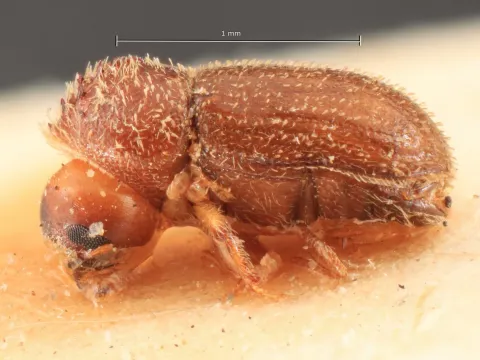
The coffee berry borer (Hypothenemus hampei) is a small beetle belonging to the Curculionidae family. It is widely recognized as the most destructive pest of coffee crops worldwide, capable of devastating yields.
What the section contains
Coffee berry borer
Adult females are dark brown, nearly black, and about 1.5–2 mm long. They are the only members of the species capable of flying, which allows them to travel between trees and infest new coffee berries.
Males are smaller, flightless, and exhibit a unique life strategy: they spend their entire life cycle inside a single coffee berry, mating with siblings and rarely emerging to the external environment.
The life cycle is completed entirely within the coffee berry. Eggs are laid in galleries, and larvae develop by consuming the coffee endosperm, which serves as both their primary food source and shelter.
Developmental speed is highly dependent on humidity and temperature. Under optimal conditions of high temperature and moisture, the lifecycle can be very fast, leading to multiple overlapping generations throughout the year.
The damage is caused primarily by the female boring into the endosperm of the coffee berry to lay her eggs. The resulting larval feeding creates extensive tunnels that destroy the structure of the bean.
Coffee berries can be attacked at various stages, but the most damage occurs when the berries reach a degree of hardness suitable for the larvae to develop, often affecting the quality of the marketable product.
Secondary damage is caused by the introduction of opportunistic fungi and bacteria into the berry through the entrance holes, leading to rapid rotting of the fruit and further yield reduction.
Economic losses are severe because infested beans have a lower market value or are rejected entirely due to the presence of holes, "bean scrapings," and the associated microbial contamination.
If not managed, the infestation can spread rapidly throughout the plantation, leading to high percentages of crop loss, particularly in humid regions where conditions are ideal for the pest.
The most distinctive sign of infestation is the presence of small, circular entry holes on the berry surface, usually located near the crown or the blossom end of the fruit.
When the bean is cracked open, one can find the presence of adult beetles, larvae, or pupae, along with characteristic powdery frass resulting from the boring process.
Premature ripening and drop of infested berries are common in heavily attacked plantations, serving as an early warning for farmers to initiate scouting and monitoring programs.
Scouting involves inspecting berries for entry holes and collecting a sample to determine the percentage of infestation, which helps in deciding whether intervention is economically justified.
During the harvest, processed coffee may show beans with visible damage, which significantly impacts the cup quality and the final grade of the coffee product.
Sanitation is the cornerstone of control. This involves stripping the tree of all remaining berries after harvest and collecting any fallen fruit from the ground to eliminate breeding sites.
Mass trapping using specialized traps baited with an attractant blend of methanol and ethanol is a common, non-toxic method to reduce adult female populations in the field.
Biological control agents, particularly the entomopathogenic fungus Beauveria bassiana, have been successfully implemented to infect and kill the beetles within the berries.
- Sanitary harvesting practices.
- Use of attractant-based traps.
- Application of biological pesticides.
Proper canopy management, including regular pruning, creates a less favorable environment for the beetle by increasing airflow and reducing the humidity within the coffee tree structure.