
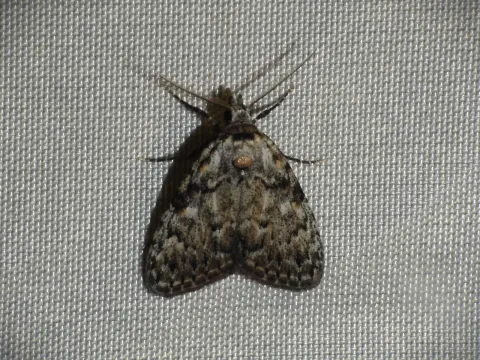
Meganola strigula
Meganola strigula
Meganola strigula is a small nocturnal moth belonging to the family Nolidae. The adult moth has a wingspan typically ranging from 18 to 24 mm.
What the section contains
Meganola strigula
The forewings have a characteristic grayish-brown coloration with a series of dark transverse lines, providing excellent camouflage against tree bark.
The caterpillar of this species grows up to 20 mm in length. It is covered in sparse hairs and features brown or gray tones with a lighter dorsal stripe.
The pupa is dark brown and robust, often hidden within a tough silken cocoon attached to bark or deep inside crevices on the tree trunk.
The species is a typical member of the entomofauna of deciduous forests and orchards, favoring moderately humid environments during the summer months.
The primary food sources for the larvae are the leaves of various deciduous tree species, including those from the Rosaceae family.
Significant damage is observed on fruit crops, such as apple and pear trees, as well as oaks and beeches located near wooded areas or shelterbelts.
Larvae feed actively on the leaf lamina, usually starting from the margins or skeletonizing the leaf, leaving only the primary veins intact.
High infestation density can lead to the defoliation of entire branches, which negatively impacts the photosynthetic efficiency of the tree.
Repeated or severe damage weakens the host tree, lowering its immunity and winter hardiness, making it susceptible to secondary pest or disease attacks.
Adult moths typically fly during the summer months, usually from June through July, depending on the local climate and temperature conditions.
The species is univoltine, meaning it completes only one generation per year, making the seasonal timing of life stages quite predictable.
The species overwinters as a late-instar larva, seeking shelter under bark flaps or in leaf litter until the following spring.
Active larval feeding is observed in the spring, coinciding with bud burst and the emergence of new, succulent foliage.
Pupation generally occurs in late spring or early summer within dense cocoons, followed by the emergence of the adult moths later in the season.
The most common visual sign of Meganola strigula presence is the appearance of jagged or skeletonized leaves in the canopy during late spring.
Caterpillars can be detected by inspecting the underside of leaves or searching bark crevices where they often remain hidden during daylight hours.
The presence of dense silken cocoons on trunks and branches at the beginning of the summer season is a clear indicator of pupation activity.
- Irregular holes along leaf margins.
- Skeletonized leaves (only veins remain).
- Silken webbing in areas where larvae are feeding.
- Presence of frass (droppings) on leaves below feeding sites.
During mass outbreaks, severe foliage damage becomes noticeable from a distance, changing the canopy color to a dull brown or gray.
An effective cultural control method involves cleaning tree trunks of dead, loose bark where caterpillars frequently find overwintering sites.
The use of biological control agents based on Bacillus thuringiensis is highly effective against young larvae without harming beneficial insects.
If population levels are high, targeted application of contact-stomach insecticides may be required during the period of peak larval feeding.
Encouraging natural predators, such as insectivorous birds and predatory insects, can significantly help in suppressing the pest population.
Removing and composting or burning fallen leaf litter in autumn helps reduce the overwintering population density of the pest within the orchard.