
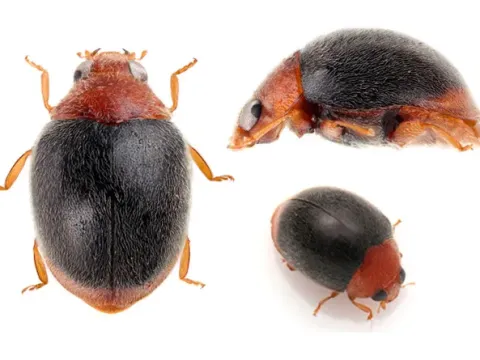
Green Scymnus
Scymnus viridulus
The Green Scymnus (Scymnus viridulus) belongs to the ladybug family (Coccinellidae) of the order Coleoptera. Unlike most of its carnivorous relatives, this species has specific feeding preferences, making its status within the agroecosystem complex.
What the section contains
Green Scymnus
Adults have a small, rounded body covered with fine hairs, giving them a matte appearance. Coloration ranges from yellowish-green to olive, often with dark spots on the elytra that may merge together.
The insect undergoes a complete metamorphosis: egg, larva, pupa, and adult. The larvae also possess a characteristic elongated shape and are covered with a light waxy coating, which camouflages them on leaf surfaces.
It is important to distinguish this species from beneficial predatory coccinellids, as the Green Scymnus can exhibit phytophagous behavior under certain conditions, damaging plant vegetative organs.
In natural habitats, the population of this species is distributed unevenly, but when the biological balance in an agroecosystem is disrupted, their numbers can increase dramatically.
The main crops susceptible to damage during mass reproduction of this species are legumes, as well as certain species of solanaceous and brassicaceous plants. The pest prefers young shoots and tender leaf tissues.
Adult beetles and larvae damage the leaf epidermis, consuming the parenchyma and leaving behind characteristic "windowing" or perforated damage. High pest density leads to partial skeletonization of the leaf blades.
Damage to growth points results in stunted plant development, reduced photosynthetic intensity, and consequently, a decrease in the overall yield of the agricultural crop.
In young plants, damage to inflorescences is possible, which critically affects the productivity of pulse crops, reducing the number of pods and the quality of the harvested grain.
Damage during drought periods is particularly dangerous, as weakened plants are unable to compensate for the loss of leaf assimilation surface area.
Insect activity begins with the onset of sustained positive temperatures in spring, usually in late April or May, coinciding with the active growth phase of most crops.
During the summer period, a peak in reproduction is observed, often linked to the availability of abundant food sources provided by weed vegetation in fields and field margins.
The life cycle includes the development of several generations per growing season, which facilitates rapid population growth under favorable weather conditions.
In autumn, adults migrate to hibernation sites, which include plant debris, leaf litter, or the topsoil layer near field borders.
The critical period for monitoring is the budding and early flowering stage, as this is when the pest causes the most significant economic damage to the crop.
The first sign of the pest is the presence of small beetles on the underside of leaves, which quickly drop into the grass or cling tightly to the stem when disturbed.
Light necrotic spots appear on the leaf blades, which gradually turn into irregular holes that pierce through the leaf.
A characteristic sign is the presence of pest excrement on the leaves and specific traces of epidermal damage, which are easily distinguished from the feeding patterns of chewing lepidopteran larvae.
- Yellowing of leaf margins due to impaired tissue nutrition.
- Retarded internode growth in young plants.
- Deformation of apical shoots in areas where larvae cluster.
When inspecting fields, attention should be paid to the condition of the lower leaf tiers, where pests prefer to cluster during daylight hours.
Agrotechnical methods include crop rotation and timely weed control, as weeds serve as reservoirs for pest reproduction at the beginning of the season.
Deep autumn plowing is important as it destroys hibernation sites for the adults and reduces the population size for the following year.
If the economic threshold of damage is exceeded, the use of contact-stomach insecticides registered for use on specific crops is recommended.
It is necessary to rotate products from different chemical groups to prevent the development of resistance in harmful organisms and maintain treatment effectiveness.
Biological control methods involve maintaining natural enemy populations in the agroecosystem, although during mass outbreaks, the use of entomophagous insects may not be sufficient on its own.