
Zygaena viciae
Zygaena viciae
Description
How to identify
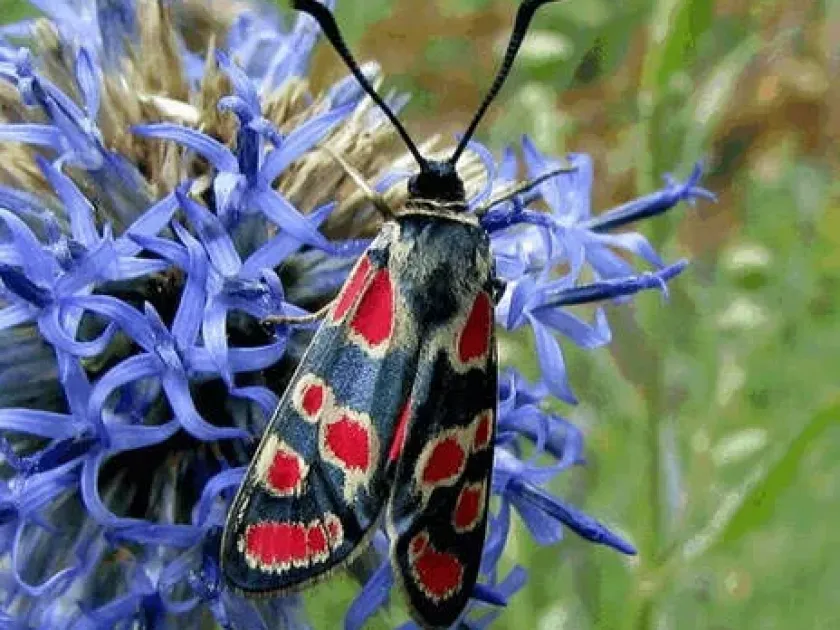
Zygaena viciae, commonly known as the New Forest Burnet, belongs to the family Zygaenidae within the order Lepidoptera.
The adult moth has a wingspan of approximately 30-35 mm and is characterized by a dark metallic forewing with five distinct red spots.
Larvae are relatively short, yellowish-green in color, and feature a series of black spots along their sides as aposematic coloration.
The life cycle includes complete metamorphosis: eggs, larvae, pupae, and adults, which is typical for the Zygaenidae family.
These moths are diurnal, preferring sunny meadows and edges of fields where host leguminous plants are abundant.
What it damages
The larvae of Zygaena viciae feed primarily on various leguminous plant species, which can lead to agricultural concern in forage crops.
Major host plants include species of clover (Trifolium), vetch (Vicia), and sweet clover (Melilotus), which are vital for pasture production.
Larvae cause damage by consuming the leaf tissue, which can significantly reduce the photosynthetic area of the affected plants.
High infestation rates can lead to stunted growth and reduced yields in fodder production areas during the peak growing season.
While often found in natural habitats, in dense agricultural stands, their feeding activity can weaken individual plants and degrade forage quality.
When it appears
The flight period for the adult Zygaena viciae typically occurs during the summer months, specifically from June through August.
Eggs are laid by females on the undersides of host plant leaves, ensuring that hatching larvae have immediate access to food.
Hibernation takes place in the larval stage, usually within the soil layer or among dense vegetation at the base of the stems.
Larval activity intensifies in spring as temperatures rise, leading to rapid development prior to the pupation phase in early summer.
The pupation occurs in a characteristic spindle-shaped cocoon, which is firmly attached to the stems or leaves of host plants.
Signs of infestation
Visible signs of infestation include irregular holes or edges eaten away from the leaves of leguminous crops.
Direct observation of larvae on the foliage is possible, especially in the early morning or late afternoon hours when they are most active.
The presence of white or yellowish silken cocoons on plant stems is a definitive indicator of the pest's presence in the field.
Patches of withered or thinning vegetation in clover or alfalfa fields may indicate higher larval densities in those specific areas.
The sight of adult moths flying over the crop canopy during sunny days confirms the ongoing reproductive cycle of the pest.
Control measures
Cultural control practices, such as crop rotation, are essential to prevent the accumulation of this pest in legume-dominant fields.
Harvesting forage crops at the optimal time effectively disrupts the life cycle by removing food sources and destroying larvae.
Biological control agents, including entomopathogenic fungi, can be used to manage populations without relying on broad-spectrum pesticides.
Chemical intervention should be reserved for cases where population densities exceed economic thresholds, utilizing targeted insecticides.
- Deep tillage of fields to expose overwintering larvae to predators.
- Maintenance of clean field borders to reduce alternative host plants.
- Systematic monitoring of flight periods to predict egg-laying peaks.
Taxonomy
- Latin name
- Zygaena viciae
- Order
- Lepidoptera (butterflies)
- Family
- Zygaenidae
- EPPO code
- ZYGAVI
Discussion
No discussions yet — be the first.