
Coconut moth
Artona catoxantha
Description
How to identify
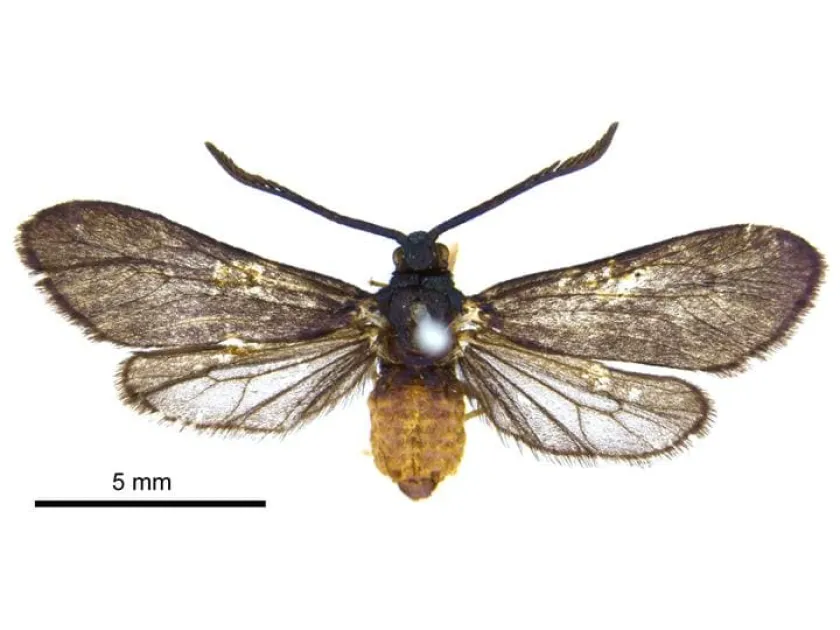
The coconut moth (Artona catoxantha) is a lepidopteran pest belonging to the Zygaenidae family. Adult moths are relatively small, with a wingspan of 20–25 mm, and possess dark wings with a subtle metallic sheen, making them difficult to spot against the foliage.
Larvae are yellowish-green in color with longitudinal stripes and short hairs. They typically develop through several instars before reaching maturity, at which point they construct silken cocoons on the underside of palm leaves to pupate.
The life cycle from egg to adult is generally short, lasting about 30 to 45 days. This rapid maturation allows the species to build up significant populations quickly under favorable tropical conditions, leading to multiple generations per year.
Adult moths are diurnal and prefer staying within the lower canopy of palm trees. Their behavior is somewhat gregarious, and they often remain in clusters, which facilitates localized, intense damage to specific areas of a plantation.
Climate factors such as temperature and humidity levels play a critical role in the pest's population dynamics. Excessive rainfall or prolonged drought can influence the survival rate of the larvae, yet the species remains highly resilient in its natural habitat.
What it damages
The primary host for this pest is the coconut palm (Cocos nucifera). However, it is also known to infest various other palm species, often causing severe economic damage to commercial plantations throughout Southeast Asia.
Larvae are the main cause of destruction, feeding on leaf tissue. By consuming the parenchyma, they leave behind the epidermal layer, which leads to skeletonization. This significantly reduces the leaf's surface area available for photosynthesis.
Severe infestations result in extensive browning of the leaves, which gives the plantation a scorched appearance. The trees become severely stressed, leading to poor fruit development, reduced yields, and, in extreme cases, the death of the palm.
Economic impact is most felt during population outbreaks. When left unmanaged, the moth can defoliate entire plantations, destroying years of investment and causing significant financial losses to farmers and palm oil industries.
Persistent feeding weakens the palm's overall physiological health, making the trees more susceptible to secondary infections and opportunistic fungal diseases. This creates a cascade effect of declining tree health that is difficult to reverse.
Signs of infestation
The earliest signs of infestation include transparent stripes on the leaves where larvae have fed. These stripes eventually turn brown as the tissue dries out, leading to large patches of necrotic foliage across the canopy.
White or cream-colored silk cocoons attached to the underside of leaflets are strong indicators of the pest's presence. Finding these clusters along the midrib is a clear sign that the moth has established a colony.
Visible colonies of gregarious larvae feeding on the undersides of the leaves are a primary diagnostic sign. Regular scouting of the lower canopy will often reveal the infestation long before it becomes visible from a distance.
A decline in nut production or premature nut fall are long-term indicators of stress caused by defoliation. Growers should correlate these yield losses with the presence of leaf damage to confirm the involvement of Artona catoxantha.
Increased adult moth activity, particularly during morning hours, often precedes a new wave of larval damage. Observation of flight patterns around the palm crowns can assist in identifying the onset of a new generation.
Control measures
Biological control is the most sustainable approach for managing the coconut moth. Encouraging natural enemies, such as parasitic wasps (e.g., Apanteles species), can effectively suppress moth populations without damaging the delicate plantation ecosystem.
Agrotechnical methods involve the systematic pruning and burning of infested leaves. This manual intervention is highly effective at reducing the number of cocoons and larvae present in the field, especially during the early stages of an outbreak.
Chemical intervention should be reserved for severe outbreaks where biological agents are insufficient. Targeted application of systemic insecticides, applied in a way that minimizes impact on pollinators and natural predators, is recommended.
Monitoring using light traps is essential for gathering data on adult population surges. By accurately timing the life cycle of the moth through this data, farmers can apply control measures precisely when they are most effective.
- Biological control: introduction of parasitoid wasps.
- Sanitation: pruning and destruction of heavily infested foliage.
- Chemical control: localized application of systemic insecticides.
- Monitoring: routine canopy inspections every 7–14 days.
- Quarantine: managing the transport of seedlings to prevent regional spread.
Taxonomy
- Latin name
- Artona catoxantha
- Order
- Lepidoptera (butterflies)
- Family
- Zygaenidae
- EPPO code
- ARTOCA
Discussion
No discussions yet — be the first.